Sunday, 28 October 2018

Kronos Quartet - WOMEX 18 Artist Award

First published in the WOMEX – World Music Expo 2018 delegate guide.


To become a pioneer in one musical stream requires immense dedication, determination and, of course, prodigious skill and creativity. To become such a leader in more than one stream must truly signal that there is some intense genius at work – genius that the Kronos Quartet possess in abundance.

They have gone through some line-up changes over the years, but Kronos Quartet as we now know them comprise David Harrington (violin), John Sherba (violin), Hank Dutt (viola), and Sunny Yang (cello). You may recognise that set-up as a string quartet, a mainstay in the Western classical tradition for over 250 years, but Kronos are anything but stuck in the past. Throughout their history, they have always been new; impressive for a group that have been going for more than 40 years.

Founded in 1973 under the intoxicating influence of Crumb’s terrifying avant-garde piece ‘Black Angels,’ Kronos have never quite been your usual quartet. They were a breath of fresh air in the often all-too stuffy world of classical music. Working with composers of cutting-edge contemporary sound art as well as revisiting the old masters, they were the very vision of counterculture where previously there was only orthodoxy. Their artistry was second-to-none and the music was of utmost importance in everything they did. They didn’t do anything that wasn’t complementary to the music, even if that meant rethinking what a string quartet looked like: if the music suited leather jackets better than evening dresses, then so be it.

All very groundbreaking, yes, but what do they have to do with WOMEX? Well, as it turns out, everything. They treat all music with the same passionate fervour and deep respect that other string ensembles would usually reserve for classical music. And that really is all music. It doesn’t matter if they’re sitting down to play Hildegard von Bingen or Harry Partch, Geeshie Wiley or Alim Qasimov, Konono No. 1 or DJ Spooky; Kronos’ music spans a thousand years and six continents. The interpretation of worldwide music is not a new thing in Western art music, but the way Kronos approach their musical adventures is revolutionary. They do not treat Western art music as immutable or unmovable. The usual balance is flipped: instead of fitting musics of other cultures into their own frame of reference, they mould their way of playing around the music itself.

This open-eared philosophy has been fundamental to the existence of Kronos, right from the beginning. Harrington tells of this lightbulb moment: “When I was 14 years of age, I had one of those moments that every one of us gets once in a while, if we are lucky, and it was while I was looking at the family globe. I realised there were a whole lot of cities other than Vienna where music composers lived. There were a whole lot of other countries with a lot of other religions and languages, and at that moment I realised I need to find out more about the kind of sounds that are present in other countries. I started to explore, and I haven't stopped ever since. I feel like I am just getting started because the world of music is so immense and anyone that thinks they know much about it is mistaken.

One of the most important factors about the Kronos Quartet is that they are many more than four. Their extended family numbers in the hundreds. Collaboration has opened up soundscapes that would otherwise be inaccessible for a humble string quartet. The list of their collaborators is mind-boggling and features some (if not most) of world music’s greatest stars. It’s no longer a surprise to see them grace the stage with guest musicians playing balafon, dan bau, tabla, bandoneón, oud, pipa or rubab, or singing in any number of languages – in fact, one of their most recent successes was last year’s album Ladilikan, made together with the Malian Trio Da Kali, hit showcasers at WOMEX 16. The key to these collaborations is that they encourage everyone involved to reach new heights; together, they are more than the sum of their parts. Each collaboration brings new dimensions to each participant’s sound, and also adds new strings to the Kronos bow, as it were. Harrington says: “I believe with every collaboration we have ever had, I have learnt so much about life, music, and my instrument. I am not competing with anybody. All I want to do is the best work we can do with those partnerships that make us better musicians, and better people. I feel this is what our collaborators do for us.

Collaboration for Kronos goes beyond performing with other musicians. It also extends to the lifeblood of our art: new music. It’s no exaggeration to say that they’re ultimately responsible for the creation of a whole new string quartet repertoire. Over 900 pieces have been composed especially for them, and one of their latest (and most ambitious) projects aims to take this even further. Over five years, Kronos have used their ‘50 For The Future’ project to commission 50 composers from around the world (25 male and 25 female) to each create a totally new piece of music for string quartet. All of the resulting pieces are then made freely available as recordings and scores for anyone to access via their website, opening up a wide range of potentially canon-upsetting music to flourish on the scene and encourage the next bright young string things.

The sheer scope and impact of this quartet’s work is impossible to condense into just a few pages of text. It would take listening to their 60+ albums, and even that would barely scratch the surface. So it is for their tireless efforts in the pursuit of the new; for bringing international music of all styles new audiences, new works and new outlooks; and for their stature as the most important string quartet of their generation, it is with delight that we award the WOMEX 18 Artist Award to the Kronos Quartet.


Photo: Kronos Quartet perform at WOMEX 18, by Yannis Psathas.

Thursday, 27 September 2018

Dur-Dur Band - Dur-Dur of Somalia: Volume 1 & Volume 2

First published in Songlines Magazine issue 142, November 2018.

Dur-Dur Band
Dur-Dur of Somalia: Volume 1 & Volume 2
Analog Africa (2CD, 108 mins)

They were the biggest band in 1980s Somalia, huge across the whole Horn of Africa, and they’re not completely unknown outside the continent, either. Dur-Dur Band’s album Volume 5 was reissued by Awesome Tapes From Africa in 2013 to much acclaim, and now Analog Africa have taken the reins to release their remaining albums. This collection includes the band’s first two albums from 1986 and 1987, as well as a couple of previously unreleased tracks.

And wow. It’s a hot one, alright. As expected from Analog Africa’s output, this album is filled with funk, and Dur-Dur go hard: the track ‘Doon Baa Maraysoo’ is an intense seven-and-a-half minutes of driving groove, and it’s not alone in that. It all has its deepest roots in Somali traditional music, particularly the powerful sounds of the saar possession rituals. There’s also a surprisingly heavy dose of roots reggae in there too, complete with amazing bass guitar by Abdulahi Ujeeri Ajami. Add saxophones, synthesisers, electric guitars and the legendary voice of Sahra Dawo into the mix, and you won’t wonder why this band was so big.

Somali music is shaping up to be a world music phenomenon; Dur-Dur Band is a great place to start.

Tuesday, 11 September 2018

Root Salad: The Como Mamas

First published in fRoots issue 422, Autumn 2018


Como, Mississippi is a small place. It’s a rural town that sits on the edge of the Mississippi Delta, home to just over 1,000 people. Its size may be diminutive, but Como is world-renowned for its history of blues; it’s the hometown of Mississippi Fred McDowell and Otha Turner, among others. In today’s Mississippi, though, the town is known for one thing: gospel. The Como Mamas are telling the world all about it.

The Como Mamas are three wonderful gospel singers: Ester Mae Wilbourn, Della Daniels and Angelia Taylor. They’re a family group – Della and Angelia are sisters, Ester Mae is a cousin – and they’ve been singing together for fun and faith since childhood. Their start as a performing group, however, came rather by chance about ten years ago, when Della was looking for a record label to listen to her nephew’s hip-hop group. There was no interest in the hip-hop, but when Daptone Records learnt of Como’s gospel tradition, they headed down from New York and were blown away at what they heard – especially that trio from the Mount Moriah Church.

Those voices! They each have their own special sound. Della’s voice is sweet and girlish; Angelia’s is low, rich and occasionally roaring; Ester’s is somewhere in the middle. Each voice complements the others perfectly, and as they all weave together – sometimes melody, sometimes harmony, sometimes dancing over and between the two – they create something that is truly soul-nourishing.

As well as releasing two records – 2013’s Get An Understanding and 2017’s Move Upstairs – Daptone also gave the Como Mamas their name. Della says it took a while to adjust to: “At first we didn’t like it, we was like ‘that sound like they kinda making fun of us.’ But when the people of Como heard that our group was named after their town – and it’s such a small town – they started getting so excited, they kept asking us will we go here, will we go there, and it seemed like the more they was able to get us to participate, the more they became interested in us, you know?” Music is in the Mamas’ blood as much as it is in the blood of Como. Angelia recalls tales of her elders, “I listened to them tell the stories of when they were younger, they went to town and they went to church all the time and sang gospel, and that was just the big highlight of their week. That’s all what Como was big on back in the day, because they had nothing else to do! No other recreation but gospel or blues, that’s all they had for fun and enjoyment!

While so many gospel stars make music closer to neo-soul or even pop, the Mamas stick to that older style. Theirs is the sound of old spirituals simmered in the birthplace of the blues, and there is no question that this is music of the soul. They’re the real deal. When the Mamas sing and dance and preach, they radiate power. Their sounds are hypnotic. In their live shows, their call-and-response sections can last five minutes or longer, endlessly repeating and subtly varying short phrases that swirl around the room. There are connections there with esoteric musical traditions from around the world: strangely, it doesn’t feel a million miles away from a Moroccan Gnawa ritual.

Gospel is just relentlessly joyous. It’s almost impossible to hear the Como Mamas sing without having a big stupid grin on your face by the end of the song. It’s telling that Angelia’s advice for the world is “don’t let nobody steal your joy.” She lives that message too – in May, she was shot through the chest in a drive-by shooting, but it was only two months later that her shining smile was lighting up all it touched as she shouted the good word at the group’s very first UK gig.

As their name implies, the Mamas have plenty of life experience to pour into their music. They picked cotton in the fields together as children, when Mississippi was still full of ‘whites only’ signs; now they’re matriarchs, with their own broods expanding to include great-grandchildren. They’ve seen it all. But for them, they couldn’t have chosen a better time to gain international recognition. “Because I am a Christian and because my life is in the Lord’s hands, I know that he knows when the best time was for me to do what we do,” says Della, “Because if I was younger, I would have a job and I wouldn’t be able to travel, there probably wouldn’t be no Como Mamas. The time is better for me now, because if I don’t want to do something, I don’t have to do that, I can just go on tour!

It would be doing them a disservice not to mention the Mamas’ deepest passion – God’s word. They’re gospel singers after all. It’s the subject of every song, and every conversation with them is liberally sprinkled with Bible quotes and teachings. Spreading the word is their life’s work and deepest pleasure, and when they’re on stage, that energy is so palpable, whatever your faith. The Como Mamas may not make music at the cutting edge, but they uphold a real roots tradition that survives and thrives in the churches of Como, Mississippi. And they do it gloriously.


Photo: The Como Mamas, by Aaron Greenhood. Left-to-right: Ester Mae Wilbourn, Della Daniels, Angelia Taylor.

Friday, 13 July 2018

The Greatest Albums You've Never Heard: Bernard Kabanda - Olugendo

First published in Songlines Magazine issue 140, August/September 2018 as my small contribution to the article 'The Greatest Albums You've Never Heard.'

Bernard Kabanda
Olugendo
WOMAD Select (1999, 55 mins)

Olugendo is simply beautiful, although it’s not simple at all. Bernard Kabanda was a master of kadongo kamu music from Uganda. That literally means ‘just a small guitar’ – and that was all he needed.

Holding his acoustic guitar in a uniquely horizontal position, he somehow managed to play a bassline, chords, melody and tap a rhythm with his elbow all at the same time, the parts interweaving with mind-bending polyrhythms that makes it difficult to believe it all comes from one man. The real mastery is that it doesn’t sound complicated; it sounds like the easiest thing in the world. On top of it all are his cheery voice and delightful whistling. Kabanda’s songs are so sincere and often dark, but they’re filled with a cheeky humour that gets you smiling along, even if your Luganda is a little rusty.

Sadly, Kabanda died soon after this record was released in 1999. He was only 40 years old. We’re very lucky that he managed to get a slice of his wonderful music recorded before then. This is a truly and utterly joyous album, and it deserves to be much more widely heard.

Various Artists - Listen All Around: The Golden Age of Central and East African Music

First published in Songlines Magazine issue 140, August/September 2018.

Various Artists
Listen All Around: The Golden Age of Central and East African Music
Dust to Digital (2CD, 132 mins)

If it ain’t exquisite, it ain’t Dust to Digital. The record label is well-known for its high-quality compilations of remastered recordings, and Listen All Around is no exception.

This is a delightful collection of recordings made by archivist Hugh Tracey, exploring a range of popular music from modern day DR Congo, Kenya and Tanzania as it was in the 1950s.

Although Tracey didn’t exactly enjoy this type of music himself, his recordings are thankfully extensive. There’s tracks based on calypso, country, big band jazz, Cuban son, Ghanaian highlife, military bands and even French folk songs, all with more or less influence from traditional music of the various regions.

Each of the 47 tracks has an interesting story to tell, and there’s lots to arouse the curiosity, such as the massed kazoos of the Dar Es Salaam Jazz Band and ‘Chemirocha III,’ a song by Kipsigis girls in Kenya in honour of country legend Jimmie Rodgers. It’s useful, then, that the 84 pages of liner notes include detailed explanations of every track, as well as a fully-referenced essay about the music and culture of the time by the compiler, Professor Alex Perullo.

The wonderful variety of sounds and impressive depth of information make Listen All Around a great resource for world music fans and ethnomusicologists alike.

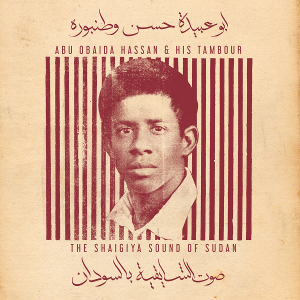
Abu Obaida Hassan & His Tambour - The Shaigiya Sound of Sudan

First published in Songlines Magazine issue 140, August/September 2018.

Abu Obaida Hassan & His Tambour
The Shaigiya Sound of Sudan
Ostinato Records (50 mins)

The Shaigiya people claim lineage from the Arabian Peninsula but grew as a culture in Nubia. The music of the Shaigiya thus has its roots in both places: the melodies use the five-note scales of the south alongside melismas and ornaments of the north, and the rhythms come from all over north-east Africa.

Ostinato Records, fresh from their Grammy-nominated Somali compilation Sweet as Broken Dates, journeyed to Sudan to dig out recordings from Shaigiya master musician Abu Obaida Hassan. He’d become a legend. His music had filled dancefloors in the 1970s but lately was assumed long-dead. Actually, he was just living quietly on the outskirts of Omdurman, and was so enthused by this project that he helped curate this collection personally.

It’s easy to hear how his music captured hearts and bodies in the clubs. With Hassan’s traditional Shaigiya tambour (lyre) – updated by his own hand with extra strings and electronics – backing his voice and only accompanied by drums and chorus, it’s amazing how funky it can be. Catchy, too: the stand-out track ‘La…La’ will have you la’ing along for days after.

Sunday, 1 July 2018

Diving Into Somali Arts with Numbi


Because this website is nominally a blog, maybe it’s time for me to write a blog? Or give it a try at least, let’s see how it goes. I thought I’d give a bit of an update on a thread that’s been going through my life lately.

As you may know, I am currently studying an MMus Ethnomusicology. I’m doing it all in one year and I started back in September, so it feels like the home stretch at the moment, but I still have the biggest hurdle to clear first, writing my dissertation. My subject is something I’ve had an interest in for a few years but I’ve never really been able to delve into it like I wanted to, so this seemed like a good opportunity. I’m looking at Somali music, or, more specifically, what music means to Somali people in the UK. I’m learning so much (as you’d hope), and it’s really exciting to engage with so many people with interesting ideas to share.

One particular organisation that has been invaluable to me so far, and is really doing stunning work, is Numbi Arts. When you know that Numbi is the name of both a traditional Somali healing dance and also the last feature film made in Mogadishu before the devastating civil war, you can kind of see where they’re coming from. Numbi Arts is an organisation in Tower Hamlets (based out of the wonderful Rich Mix, actually), where there has historically been a significant Somali population and looks at art as a way for people to engage with their community and their identity, their history and their future.

I’ve been to two events run by Numbi so far. The first one was back in February, actually at Rich Mix. It was rather gloriously chaotic. As far as I can tell, it was the first event of the new ‘season’ for Numbi, and so the projects featured were perhaps works-in-progress leading up to the big festival in July (more about that in a little bit). But despite some rough edges, it was a load of fun. The theme for the day was Coming Here, Being Here, and that was reflected in an emphasis on kids and their connections with their families, with London and with their links to East Africa. The highlight for me was a lovely little film by Salma Bihi, interviewing her mother about her memories of Somalia, the journey to the UK and her life here. It was really well made, and provided insights for us in the audience and Bihi herself. It complemented the rest of the programme well, too, which included poetry from kids with a helping hand from Sai Murray and Mr Gee (yeah, the same Mr Gee from the Russell Brand radio shows), a short podcast and a collective creative writing exercise. After a
hearty meal (it’s always good to have a meal, right?), the event came to a close with some music led by Mohamed Maalow Nuur, who in his time was a member of at least two of the most iconic ‘golden era’ bands, Waaberi and Iftiin. With oud and bongos, and vocals provided by as many people as knew the words, the music served well to accompany a troupe of Somali dancers (you can see them on the left, there). I really don’t know much about dancing at all, and it was the first time I’d ever encountered Somali dance, but it looked good to me!

After having a really nice time at that first event, I got in touch with Kinsi Abdulleh. She runs Numbi and her passion is obvious and really inspiring. She’s an artist, first and foremost, and I think that comes across in her work. She’s not about the standard way of doing things, she likes to mix things up. Do them in a different way to get reactions that would otherwise remain hidden. Make it weird, a bit. Who else would think to work on community engagement in Tower Hamlets by arranging a yoga retreat in Gambia? We had a great conversation about all sorts of things, and I was delighted to be invited to an event co-hosted by Numbi and the British Library, called A Postcard from London, which happened just last weekend.

It was a much smaller event than in Rich Mix, with about 20 participants as opposed to the maybe couple of hundred in February. This was on purpose – it is a library, after all – but it really lent an intimate vibe to everything, and we all got to know each other a little bit, which was nice. The day started with a small tour of the library’s treasures. Unfortunately, the Library gave the task of tour guide to possibly the most boring man who worked there, and he somehow managed to make some really interesting stuff impossibly dull. But hey-ho. After that we got to what we were actually there for.

The first half of the workshop was curated by the Library’s Somali Collections Project Officer, Mahamad Ali, and it allowed us to take a small dive into the history of written Somali literature in English, Arabic and (after 1972) Somali. There was all sorts: poetry, novels, political pieces and academic writing, even some interesting, albeit rather distasteful, colonial works. What piqued my interest the most, though, wasn’t a book at all, but a long wooden board, covered in hand-inked Arabic (pictured right). One of the participants, a wonderful gentleman called Mr Ali Ahmed Hussein, who used to be the director of the National Museum of Somalia and was a font of knowledge throughout the day, explained to us that this was part of a Qur’an. It was a teaching tool: children were taught the Qur’an and how to write Arabic at the same time. They wrote out each Surah over and over until their penmanship was perfect and they had it memorised by heart. Each time they wrote it out, the board was washed, dried and used again.

Another element that was presented was a Somali philatelic collection…or, to you or me, a bunch of stamps. Surprisingly engaging, actually! They covered a big range of history and subjects, from architecture, art and dance, to denouncing apartheid and celebrating the Somali language and the Arab League. There were stamps from various iterations of independent Somalia, and of the colonial territories of Somaliland and Jubaland, and even a stamp representing Somali refugees. The details on these tiny stamps were impressive. This formed the seed of our workshop: we got a big bunch of photocopied stamps to chop up and remix into what we related to Somalia, and maybe even write them as if a postcard. I have never been one gifted in the visual arts, so mine was a rather feeble offering, but there was some wild creations. Most fun for me was getting to mill about, looking at everyone’s artistic efforts and having some really insightful chats.

After both of these events, I’m getting excited for the next one, it’s just around the corner! Numbi Arts host a festival each year, and each year has a different theme and focus city. Usually the city is in Somalia, but this year the focus is London, and the theme is Repair and Rebellion. This means the focus is very much on diaspora, and allowing people to negotiate and contest their experiences and opinions of being part of a diaspora through different artistic formats and cultural practices, including oral and written language, music, dance, film and theatrical performances as individuals and as groups. The festival will feature many different aspects and events including site-specific installations, an open archive, a mobile recording studio, documentation sites and intergenerational conversation.

The first event will be held at Rich Mix on 21 July to launch the festival, where Numbi will share all the interesting items in their own archival collection and encourage people to add to it themselves with workshops in smartphone storytelling and studio portraiture. After will be an evening of poetry (Somalia is well-known for being a country of poets) and music, again from Mohamed Maalow Nuur. Perhaps the most exciting for me is the big finale of this opening event: a conceptual music and spoken word tribute to Poly Styrene. She was best known as the frontwoman of the punk band X-Ray Spex, and also half-Somali. Her daughter, Celeste Bell, is also a musician and a film-maker; she’s currently making a film about her mother and will be helping to organise this tribute. Who knows, maybe we will get some Somali-flavoured punk going on? Perhaps I should bring my saxophone…

So, that’s it I guess. If you’re in London, you know where I will be on 21 July, you should come in and join the festivities! You can get your tickets here. See you then!