Showing posts with label Press Release. Show all posts

Tuesday, 25 February 2025

Press release: Ukandanz - Evil Plan

First written as a press release for the album for Ballantyne Communications.

Ukandanz
Evil Plan
Compagnie 4000 (28 mins)

This ain’t yer same old Ethiojazz. Ukandanz have pioneered the sound of Ethiopian crunch – at once soul and heavy metal, jazz and punk, and indisputably Ethiopian – and they’ve perfected it too. A Lyon-based quartet of complex rhythms, screaming saxophone and distorted bass thrums unite under the honeyed voice Asnaké Gebreyes, stalwart singer of the buzzing Addis Ababa scene that he still calls home. Asnaké’s Amharic-language vocals stir the soulful sweetness of Ethiopia’s classic pop into the band’s beefy, bold and intelligently aggressive style.

It’s a refreshingly unexpected synergy that has gained plaudits ranging from revered Éthiopiques producer Francis Falceto to comedian and music obsessive James Acaster. Channelling musical powerhouses as diverse as Ethiopian singer Tilahoun Gessesse and the legendary Black Sabbath, Ukandanz have been not-so-quietly making waves for the past 15 years – now they pay tribute to these musical heroes without imitation, only surprises.

Ukandanz were founded as a four-piece in the mid-2000s in France by bassist / guitarist Damien Cluzel and saxophonist Lionel Martin. But there was something missing, an essential spark that would transform their sound and take them to the next level. That spark was the golden tones of Addis Ababa soul singer Asnaké Gebreyes, a connection made by Falceto himself. Asnaké had been a staple on the Addis scene since he was 16 – he moved from his small home city of Kibre Mengist to earn his stripes as part of the legendary Police Orchestra alongside future stars Getatchew Mekurya and Hirut Bekele, before breaking out into stardom in his own right in the 1980s and later even contributing to Éthiopiques Vol. 15: Jump to Addis. He was a world away from the Ukandanz style, but his acrobatic, flexible voice was a perfect fit, and the connection was clear: “He didn’t know about rock music, about Sabbath, about Iron Maiden, but he has that same energy! It’s like the traditional musicians: it’s not rock, but they’re really rocking,” says Cluzel. And he’s no stranger to collaboration, having worked with Ethiopian legends Getatchew Mekurya and Mohammed Jimmy Mohammed, as well as Dutch jazz-punk collective The Ex and drum experimentalist Han Benninck. With Asnaké on the team, the four became five in 2010, and they’ve not looked back. The musicians live a continent apart, swapping artistic interrogations back-and-forth via WhatsApp, bashing rough-hewn arrangements into shape before polishing them through live tours and studio jams.


Rather than taking obvious cues from the well-known Ethiopian composer Mulatu Astatke like so many bands before them, they instead look to the country’s most beloved musicians – the soul superstars of the 1960s and 1970s. Icons such as Tilahoun Gessesse, Getatchew Kassa and Muluken Melesse are held up as the pantheon of pop music. But Ukandanz aren’t interested in faithful covers or the meaningless meanderings of Westerners trying to make Ethiopian music. “We don’t imitate and we don’t want to make the folklorical fusion shit. Ethiopians play Ethiopian music better than we can.” So the musicians do what they do best, creating an angular, angry math-punk, building complex polyrhythmic and polymetrical tensions based on jazz and allowing Asnaké to work his magic over the top, the two styles converging in the use of the kiñit – the iconic Ethiopian pentatonic scales that makes the music so distinctive.

Now after 15 years as a five-piece, Ukandanz are looking back to their heroes and sources of inspiration of generations past, and finding in them important meanings for the modern day. This is clearest in their intriguing cover of Black Sabbath’s 1970 protest song ‘War Pigs’. As well as hearing the musical relationship in the pentatonic feel and raw, sometimes mysterious energy, Asnaké particularly connected with the song’s anti-war lyrics, which resonate with Ethiopia’s current situation locked in a civil conflict since 2018. Sabbath’s lyrics are translated into Amharic and sung with a keening, melismatic passion. Such politically-charged statements can be dangerous in today’s Ethiopia, but some songs are too important to keep quiet.

On either side of the Black Sabbath classic are two songs associated with the kings of Ethiopian soul. ‘Yene Felagote’ (My Interest) was made famous by Tilahoun Gessesse, and Asnaké absolutely explodes out of the gates to open the album while Martin’s tenor sax bridges the conceptual gap between rock guitar and the sound of traditional Ethiopia, the masenko fiddle. Getatchew Kassa’s song ‘Lewsedesh Andken’ (One Day I Will Take You) is transformed by layers of cross-rhythms, spiky saxophone and funky organ grooves providing space for Asnaké’s charismatic strut. Both are love songs on their surface, but their lyrics are full of double entendre and semantic obfuscations, hiding multiple layers of deep meaning. This playful and poetic treatment is a powerful form of Ethiopian expression known as semena werk, wax and gold: entertaining words with profound significance at their core. Ukandanz make their music in the same way – complexities, contradictions and confluences interweave into a vibrant and effervescent eruption of unique Ethio-European noise.

Tuesday, 3 December 2024

Press release: Jupiter & Okwess - Ekoya

First written as a press release for the album for Ballantyne Communications.

Jupiter & Okwess
Ekoya
Airfono (36 mins)

Veteran stars of the Kinshasa street music scene Jupiter & Okwess return with their fourth album, Ekoya, representing an exciting new chapter for the band, blending their signature sound of soulful Congolese funk, rock and soukous with new influences from across Latin America, inspired by eye-opening cross-cultural encounters and the shared history of African people on both sides of the Atlantic.

Recorded in Mexico, Ekoya (‘It Will Come’) explores themes of change and resilience, of Indigenous peoples’ issues and the joys and struggles of everyday life. With guests including Brazilian singer Flavia Coelho, Mexican Zapotec rapper Mare Advertencia, and Congolese singer Soyi Nsele, and featuring lyrics in eight languages across its 12 tracks, Ekoya marks Jupiter & Okwess as both proudly Congolese and profoundly international.

This is music that is unmistakable in its origins, its rhythms and melodies shaped by three decades of evolution on the streets of Kinshasa. But Latin America looms large over Ekoya. The album was conceived in 2020, when Jupiter & Okwess were touring South America, an adventure shaped by the spectre of lockdowns. Once the tour concluded, the band were forced to pause in Mexico before returning home – a transformative experience as they found themselves immersed in Latin American culture. Jupiter reflects: “Latin America has influenced us a lot… but our music hasn’t changed, it has just been given a new dimension. When we were there, we discovered things that pushed us to think differently. Because it’s like a continuation of Africa. There are people there who have African roots, Congolese roots – they are part of the story of Africa. They are part of us, and they are a part of our music.” When it came time to record the album, Mexico was the natural destination, where they spent time in studios in Guadalajara and Mexico City, and worked with producers including the renowned Camilo Lara (Pixar’s Coco; Marvel’s Black Panther: Wakanda Forever). “Each time we visit Latin America, we’re happier, we’re more comfortable. And it’s best to record in a place with nice people, good food, and good weather!


Since his debut in 2013, Jupiter’s sound has been defined by its weight, a purposeful heaviness, a rawness, even a darkness tinting the driving Kinshasa funk-rock and the softer, more introspective and sometimes ominous moments. Those signature styles remain, but are joined here by moments of lightness, sometimes ascending to a full-on dance party with soukous at the forefront – a well-known Congolese style that itself is infused with an indelible Latin influence, shown to full effect on the song ‘Nkoyi Niama’. Okwess’ choppy guitars, bouncing bass, glorious harmonies and pounding beats push that classic sound to the next level.

All throughout his music, Jupiter displays his mastery of the poetic word, communicating deep meanings through proverbs and parables. Lead single ‘Les Bons Comptes’ warns against being in debt to friends. “Good accounts make good friends,” sings Jupiter in French, adding in the Mongo language: “a deadbeat is like a cuttlefish, they only take and never give.” Be a good friend, be honest and pay your bills. The message is also taken up by Brazilian songstress Flavia Coelho, whose lusciously smooth and light voice works a beautiful counterpoint to Jupiter’s resonant, gravel-worn rumble. “It was good to share this with Flavia,” Jupiter explains. “She’s been a friend for a long time. When we see her at a festival, we share a song on stage, just for fun. So, when we’re in Latin America, and we’re making a new album, it was only natural to ask her to join us.

Themes of change and resilience permeate Ekoya. “Everything is changing, on a global scale,” says Jupiter. “Politics, climate change, Covid. You feel it in Europe, and we feel it even stronger in Kinshasa. But, on the other hand, tout passera – everything will pass. After life, nothing. You don’t have to be so focused on material things, on money, on property – tout passera. That’s not optimist or pessimist – it’s just the truth.” Resilience is also found in lyrics presented by powerful Indigenous women activists, including Mongo singer Soyi Nsele who calls upon the ancestors to intercede against the unthinkable destruction of the Congolese rainforest in the opener ‘Selele’; and Zapotec rapper Mare Advertencia, who leads a hard-hitting demand for rights and justice for oppressed Indigenous communities around the world on the song ‘Orgullo’, with the words: “We demand our right to exist / For the memory of those they took from us / For the justice we are still seeking!

When Jupiter was young, he wanted to follow in the footsteps of his father, who was a diplomat. But, as he says, “Destiny is complicated. Life changed, and my life was making music on the streets in Kinshasa. But now we are performing all over the world, doing interviews, telling the world about the Congolese people – well, now I have the chance to be a diplomat. I did it differently.” Developed in Kinshasa, blossomed in South America, born in Mexico and now released on the world, Ekoya continues Jupiter & Okwess’ important work as skilled wordsmiths highlighting universal issues, as champions of a world that is safe and welcoming for all, and as musical diplomats of their very own brand of forward-facing roots-focused Congo sound.


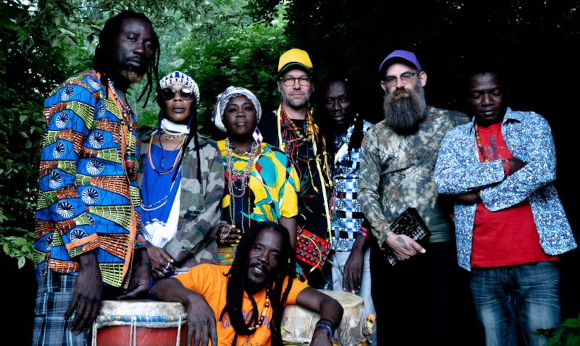
Photo: Jupiter & Okwess, by Marcelo Quiñones.

Tuesday, 10 September 2024

Press release: Dogo du Togo & The Alagaa Beat Band - Avoudé

First written as a press release for the album for Ballantyne Communications.

Dogo du Togo & The Alagaa Beat Band
Avoudé
We Are Busy Bodies (30 mins)

Following on from his self-titled 2002 debut, Togolese singer and guitarist Dogo du Togo introduces his new Lomé-based Alagaa Beat Band with the album Avoudé, released on 8th November 2024 on Canadian label We Are Busy Bodies. Recorded in less than 48 hours under the watchful eye of renowned engineer Patrick Jauneaud (Elton John, Kate Bush, Queen), Avoudé represents a new evolution of Togolese music and makes a powerful cultural statement: hard-hitting Afro-funk that builds upon the country’s musical traditions while creating a new sound to energise its future.

After two decades of living in the US and fronting the successful Afro-pop band Elikeh, Dogo saw the popularity of music from across West Africa – but Togo was never in that picture. Now splitting his time between Washington, DC and Togo’s capital Lomé, he set out to create a brand new beat that can put Togo on the musical map and that Togolese people can rally around and hold as their own: the alagaa beat.

Combining iconic rhythms of the Ewe and Mina people, such as kpanlogo, kinka and bobobo, alagaa blossoms from a complex interplay between drum kit and rhythm guitar, with a distinctive double snare hit and a guitar part based on the traditional gankogui bell pattern. Alagaa means ‘trance’ in Ewe, “because when you listen to this music,” says Dogo, “if you don't get in trance, then something’s wrong with you! The alagaa beat brings the energy right away. As soon as you bring it in, it just feels different, it takes you somewhere else.” The melodies, too, are anchored in Togo’s cultural history, using unique pentatonic scales known as mina or mami, derived from the music of the local Vodún religion and traditions that permeate everyday life in Togo.


For this album, Dogo du Togo has gone back to his roots. The Alagaa Beat Band is a reunion of friends who grew up playing music together on the streets of Lomé in the 1990s – lead guitarist Oya Yao was the one who taught Dogo to play in the very first place. Although alagaa is born from the guitar and drums, the sound is bolstered by a powerful horn section, beautiful retro synths and the unusual but inspired addition of the electric violin. Like many West African pop styles, it has elements of funk, rock, soul and reggae, but these are used only in service of the alagaa, and demonstrate the adaptability and flexibility of this exciting new style.

The whole album was recorded live in less than two days at Lomé’s legendary Otodi Studios, with storied engineer Patrick Jauneaud behind the desk. It was far from comfortable, but the vibe was immaculate: “The studio was built by Americans in the 70s. It used to have AC built in, but it's not working anymore. There's no windows, nothing. And it was hot when we were recording, it was HOT, and it was really painful. But the thing is – the sound of that studio is so great. The acoustic is so great that we decided to do it anyway. Those are the conditions: we’re hot, we’re extremely tired, we have only 48 hours. But we hit it, and played live.

The album’s opener and title track ‘Avoudé’ is what Dogo describes as “alagaa par excellence.” That’s the beat, all the way through, no messing about – a way to kick down the doors and get the energy flowing immediately. The song encourages its listeners to work hard and strive for the life they want: “Nothing is easy. Life is not a game, it is a hustle.” The song ‘Enouwo Lagnon’ continues that theme, taking the voice of a person who knows, no matter how hard things get, they can always make things better through hope, prayer and struggle, the lyrics punctuated to a pair of barnstorming solos on trumpet and synth. ‘Adzé Adzé’ is the only song on the album that doesn’t use the alagaa beat. Instead it’s based on the limping 12/8 agbadza rhythm – a martial beat, originally used to celebrate victorious warriors. It makes sense that this is also the most political song on the album, urging the youth of Africa to create a bright future for the continent and to refuse to allow their countries to become puppets of Western governments.

With Avoudé, Dogo du Togo & The Alagaa Beat Band make a sound that is undeniably Togolese, steeped in the history of the country while making a contemporary sound that lights the way for exciting future directions. Get ready to be entranced by the alagaa beat – there’s a new style on Africa’s musical map.


Photo: Dogo du Togo & The Alagaa Beat Band, by Wilfried Good Eyes.

Tuesday, 20 June 2023

Press release: Chouk Bwa & The Ångströmers - Somanti

First written as a press release for the album for Ballantyne Communications.

Chouk Bwa & The Ångströmers
Somanti
Bongo Joe Records (38 mins)

Following on from their successful first collaborative album Vodou Alé (2020), Chouk Bwa and The Ångströmers release their second full-length LP, Somanti, with Bongo Joe Records on 6th October 2023. This mature but celebratory reunion mixes the powerful Vodou rituals of Haiti with compelling avant-garde electronic music and dub, born amid the creative whirlwind of a live tour.

The two groups come from very different traditions. Chouk Bwa hail from Gonaïves, the heartland of Haitian Vodou and the birthplace of the country’s independence; their mizik rasin (roots music) is steeped in the profound spirituality of the lakou temples, the revolutionary history of their hometown, and the African heritage of its people. Brussels-based duo The Ångströmers channel their passion for musique concrète, dub, hardcore and industrial and their expert knowledge of all manner of analogue electronics into a sympathetic but all-encompassing production. Both groups are connected by their ability to whip their listeners into ecstatic trance.

Together, their music ebbs and flows. Sometimes it smoulders like crackling embers, sometimes it explodes; sometimes it is a cappella, sometimes a wall of distorted drumscapes; sometimes uplifting, sometimes disturbing. It is always both deeply traditional and deeply contemporary, a union of America, Africa and Europe. In every direction, it is dance, trance music – equally at home at a rave or in a temple.


First crossing paths in 2016, the two groups began to formulate a joint project that led to their first performance together in 2018, and then quickly onto recording sessions. After a year of production, their debut album made it into the world. A lot has happened since then. A globally-enforced international separation meant that a tour planned for May 2020 was cancelled. The groups wouldn’t meet again for two-and-a-half years.

But the collaboration lived on, with two dubwise 12” EPs, Ayiti Kongo Dub #1 and #2, both released in 2022. When Chouk Bwa and The Ångströmers were finally reunited in May 2022, it was for an intense European tour. 32 concerts were interspersed with near-constant rehearsals, discussions, experiments, intercultural dialogue, and meticulous musical negotiations. It was during this time that the material for Somanti grew, organically.


Being reunited again meant that we played with those tracks, we arranged them in many ways, and they became something totally different,” says Frederic Alstadt of The Ångströmers. “We had toured for about two months and we set up three days of recording sessions at a studio in Brussels, and basically we recorded everything in one day. There was one day of set-up, one day of recording and one day of fine tuning. We were playing live in the studio, and then we spent about two weeks producing it. It was done pretty fast, actually. It really came from the live energy.

Although the process was much quicker, it has resulted in a more mature sound based on the closeness of the collaboration itself, the mutual respect and a deeper understanding of each other’s traditions, methods, and tastes.

Where Vodou Ale focussed on new compositions and narrative songs, Somanti is an album of ritual. Most of the pieces are based on ceremonial music with traditional lyrics disclosing wise proverbs. It is important to the musicians that the complexity and solemnity of the religious aspect is retained. Michael Wolteche, manager of Chouk Bwa, explains: “In Vodou, all of the rites have different rhythms. We could choose the ones that would most please Western ears, but we will not do that, we keep all of the different aspects. This is our way to respect a very complex, subtle culture. It is not just entertainment music. It is meant to bring the people to trance, but for people in Europe or the US, to bring a spiritual connection to the party.

Chouk Bwa’s music is all-acoustic: it is the sound of wood, skin, metal, horn, and the human voice singing in Haitian Creole. There are strong cultural memories and rhythms within this music, in its invocations of the ancestral lands – the African kingdoms of Oyo, Kongo and Dahomey – and the shouted proclamations of the transcontinental Vodou spirit-deities of Legba, Ogou and Inan. There is a joyfulness in the songs, in their beautiful, relaxed harmony and dance-demanding rhythms, but there is also a darker side, an empathetic rage, bearing witness to injustice and advocating for the world’s poor.

The addition of The Ångströmers changes none of that, yet together they create a truly unique style. The cultures and their musics are combined carefully. The electronics are analogue, and vintage. No click-track, no sequencers, nothing that constricts music’s humanity in favour of rigidity and exactness: this is not a collaboration that can be restrained by the tyranny of computers. These rhythms, textures and tempos undulate like liquid, an effect only possible when each musician reacts to every other around them. As the Haitian and Belgian musicians are connected, the synthesised is linked directly with the organic, creating a seamless, cross-cultural, electro-acoustic percussive barrage. Musicians, instruments, electronics, audience, spirits: all are joined as one on Somanti.


Photo: Chouk Bwa & The Ångströmers, by Davide Belotti.