Showing posts with label Sudan. Show all posts

Friday, 6 October 2023

Sawa Sawa - Sawa Sawa

First published in Songlines Magazine issue 192, November 2023.

Sawa Sawa
Sawa Sawa
Jinn Records (33 mins)

Sawa Sawa (‘All Together’ in Sudanese Arabic) is a project that unites artists from across Sudan to make a statement for peace and togetherness within the country. This debut release spreads that message as a multi-discipline, multimedia concept album made up of eight artworks, eight short stories and eight pieces of music, all specially commissioned from a diverse range of artists.

The musical side of things takes in almost as many stylistic influences as performers – of whom there are 19. The main sounds are Afro soul, reggae and lightly funky rock, with Sudanese and pan-African scales, rhythms and timbres sprinkled throughout. Unfortunately, it’s all a bit thin. The reggae is bland, the soul feels obvious and the rock guitar solos are often cheesy. Perhaps it’s a symptom of over-fusion. Sudanese music can be so exciting and spicy! It’s a shame that this album doesn’t showcase that to its fullest.

But really, that’s all less important than the project’s noble goal of unity and celebration, made all the more poignant by the recent conflict in Sudan. Millions of civilians have been displaced by the war, including members of the Sawa Sawa family. All credit to those involved in this worthy endeavour – the positive, human impact of art should always be celebrated.

Friday, 16 June 2023

Jantra - Synthesized Sudan: Astro-Nubian Electronic Jaglara Dance Sounds from the Fashaga Underground

First published in Songlines Magazine issue 189, July 2023.

Jantra
Synthesized Sudan: Astro-Nubian Electronic Jaglara Dance Sounds from the Fashaga Underground
Ostinato Records (36 mins)

Jaglara is the sound of one man and one keyboard, emanating from the rural al-Fashaga region near the tripoint of Sudan-Ethiopia-Eritrea. The man is Jantra, and with his trusty Yamaha keyboard (hacked to produce distinctive Sudanese tunings and rhythms), he is known for hosting raucous street parties where he improvises, invents and innovates his music on the spot for hours on end.

This is Jantra’s first-ever release, and it’s a unique creation: a combination of his old cassette recordings and new performances from those legendary parties recorded live and directly from the keyboard, literally re-mixed together by producer Janto Koité. It’s a masterpiece of sympathetic production wizardry – and necessary to boil down Jantra’s non-stop improvisations into a ten-track album.

Each track starts as if it’s going to be fairly simple synth-powered reggae-influenced pop, but then slowly evolves into complex layers of melody, chords, rhythms and effects that expand until they fill the aural space. The slightly-loping beats push constantly forwards, compelling you to dance with your chest and shoulders, while the melodies reflect the musical cultures of Afro-Arabic Sudan in the West and the Horn of Africa in the East, and the universe beyond. Jantra and his jaglara sound are revelations of intergalactic retrofuturism from the Sudanese countryside.

Friday, 3 March 2023

Ebo Krdum - Revolt for Change

First published in Songlines Magazine issue 186, April 2023.

Ebo Krdum
Revolt for Change
Epidemic Sound (27 min)

After his 2021 Top of the World album Diversity, Ebo Krdum has followed up with two albums for the royalty-free music platform Epidemic Sound in 2022: Love and Struggle in May and the latest Revolt for Change in December.

Originally from the Darfur region in western Sudan, Krdum is now based in Sweden. He’s worked with many Swedish musicians in the past, but for this album he’s mostly on his own, singing and playing guitar, ngoni and fiddle among others, occasionally helped out by a bassist or percussionist. Although he describes his music as ‘Afroblues and Afrobeat,’ his sound is very much anchored in West Africa. The way he constructs his songs and shapes his guitar lines shows a clear lineage to the Songhai style of Ali Farka Touré, from whose records Krdum learnt guitar as a child. In fact, apart from the languages used – mostly Sudani Arabic, with some Darfuri Masara and Daju – there are places where this could easily be mistaken for the latest album by a Touré or Traoré from Mali.

This album doesn’t have the same scope as Diversity in terms of style, but Krdum gives solid performances throughout, along with impassioned lyrics on war, corruption and hope.

Friday, 17 June 2022

Noori and his Dorpa Band - Beja Power! Electric Soul and Brass from Sudan’s Red Sea Coast

First published in Songlines Magazine issue 179, July 2022.

Noori and his Dorpa Band
Beja Power! Electric Soul and Brass from Sudan’s Red Sea Coast
Ostinato Records (41 mins)

A unique instrument is always eye-catching, and Noori’s incredible self-made (literal) fusion of an electric guitar and a tambour lyre certainly grabs the attention. The music he makes with it is even more impressive.

Noori and his band (tenor sax, rhythm guitar, bass and percussion) are Beja, an oppressed minority group from the coastal region of eastern Sudan. Their self-appointed task is to keep the culture of the Beja alive, but their music is no museum-piece. The album’s six instrumental tracks bring to mind raw blues and smoky jazz in equal amounts. The choppy guitar and swirls of saxophone are filled with loping Saharan rhythms and a pentatonic feel that could only be from the Horn of Africa, marking it squarely in the same family as Ethiopian and Somali music. At points it really does sound like a laid-back meeting between Tinariwen and Mulatu Astatke. It all feels like an intimate jam – structured but loose, with space for each musician to stretch out and make the sound their own. The approach creates understated music, in a way that only emphasises its cool.

Beja Power! is a wonderful album by a unique group, showcasing the riches of an underrepresented culture with an effortlessly hip sound – powerful indeed.

Friday, 17 December 2021

Ebo Krdum - Diversity

First published in Songlines Magazine issue 174, January/February 2022.

Ebo Krdum
Diversity
Supertraditional (55 mins)

Diversity is a theme in Ebo Krdum’s life. Growing up in a village in the Darfur region of Sudan, his family and friends spoke many languages between them, and the radio played music from all over West, North and East Africa. He now lives in Sweden, having fled war and political upheaval 11 years ago.

In his debut album, the self-styled ‘African blues’ guitarist and singer explores his own personal meaning of diversity – ‘peace and harmony among people despite their differences’ – using eight languages across the 12 tracks to sing about unity, justice, organisation, activism and the fight for peace. Diversity also means that Krdum isn’t fixed to one particular style. There are different influences dotted throughout: some Arabic, some reggae, and a pleasant thread of Scandinvanian folk, courtesy of performance and production from Swedish folk legends including Ale and Anna Möller. There’s also more than a hint of Krdum’s first and largest influence, Ali Farka Touré – in fact, the track ‘Aysé Konga’, appears to be a take on Touré’s classic ‘Ai Du’. Elsewhere, balafon, djembe, calabash and Tuareg-like guitar add more tones and textures that give the album a decidedly West African bent.

With Diversity, Krdum has made a solid debut album, and one that lives up to its title in terms of music, lyrics and philosophy.

Friday, 8 October 2021

Nabra & Ligeti Quartet - Sounds of Sudan

First published in Songlines Magazine issue 172, November 2021.

Nabra & Ligeti Quartet
Sounds of Sudan
Nabra (38 mins)

Bristol-based oud players Ali Elmubarak and Knud Stüwe came together as Nabra in 2015 to explore a shared love of Sudanese music. The duo’s debut album sees them teaming up with the Ligeti string quartet to give a new twist to classic Sudanese pop.

Sudanese music is always a treat – inherently African and unmistakeably Arabic, full of pentatonic groove and dancing rhythms – and this set of seven folk-leaning pop songs from Sudan’s ‘golden era’ shows it well. The Ligeti Quartet’s strings bring a lightness that complements the earthy ouds and add a distinct classical flavour while maintaining the playful nature of the songs.

The string arrangements are clearly – and admittedly – inspired by the Kronos Quartet, and are most effective during the more poetic and lyrical pieces, where their parts can swell and swirl around the melodies of Elmubarak’s voice. When the pieces skew towards the dancier side of things, however, the quartet can struggle a little to find space among the rhythm. Strings are great for subtlety and emotion but sometimes what you really need is the nice, heavy boom of the sadly absent tar (frame drum).

Sounds of Sudan is a solid debut and interesting collaboration – definitely one to keep on your radar.

Friday, 23 August 2019

Sinkane - Dépaysé

First published in Songlines Magazine issue 151, October 2019.

Sinkane
Dépaysé
City Slang (41 mins)

Sinkane’s Ahmed Gallab was born in London to Sudanese parents, moved to Omdurman at age five and then eventually to the US; it’s a story that will be familiar to millions in diaspora communities around the world.

Gallab’s contemplations on his identity as an Amreekee-Sudani (Sudanese-American) are the theme that runs through Dépaysé. His lyrics ponder of his place in a world full of unities and divisions that come in these times of Trump’s Muslim ban and the recent overthrow of Sudanese dictator Omar al-Bashir; despite these weighty topics, the feeling is one of cautious positivity and hope.

This theme of multi-identity isn’t just expressed in words. Sinkane’s overall sound is one of indie rock and pop, but there are nods to Sudanese music ingrained throughout the album. This usually comes in the subtle forms of polyrhythmic percussion, pentatonic scales and occasional Arabic refrains, but some tracks, such as ‘Stranger’ and ‘Ya Sudan’, are full-on tributes to the music of Gallab’s parents’ generation. It’s sort of like if Vampire Weekend were obsessed with vintage Sudanese pop rather than Congolese soukous.

The result is compelling on each level: the lyrics are thoughtful and insightful, and the music turns them into feel-good summer anthems.

Thursday, 6 December 2018

The Scorpions & Saif Abu Bakr - Jazz, Jazz, Jazz

First published in Songlines Magazine issue 144, January/February 2019.

The Scorpions & Saif Abu Bakr
Jazz, Jazz, Jazz
Habibi Funk (44 mins)

Jazz. Jazz? Jazz! Jazz. Well, except, not really. Barely any jazz at all, actually. Funk and soul definitely, and more besides, but jazz…not so much.

This record by Sudanese band the Scorpions with singer Saif Abu Bakr was originally recorded in 1980 in Kuwait. It’s since passed into a degree of legend among record collectors, with copies going for up to $1000 on eBay. Now Habibi Funk has reissued it for those of us without such expansive purses.

The album starts with a couple of instrumentals, but it really gets going when Abu Bakr joins in. His voice is full of personality and gives a good contrast to the tightness of the band’s groove. But yes, for all the title’s talk of jazz, stylistically there’s much more funk than swing, and it even drifts into Motown territory on occasion. There’s not that much to mark the music as Sudanese, either. Apart from the vocals and a sometimes pentatonic feel, the record could have been made across the Atlantic. In fact, the track ‘Bride of Africa’ wouldn’t have sounded out-of-place in 70s Kinshasa; it’s a lovely take on rumba Lingala.

In the end, this album probably isn’t worth $1000. But it’s a goodn nonetheless.

John Falsetto & Mohamed Sarrar - Sounds of Refuge

First published in Songlines Magazine issue 144, January/February 2019.

John Falsetto & Mohamed Sarrar
Sounds of Refuge
Good Chance (33 mins)

John Falsetto and Mohamed Sarrar met as fellow actors in the award-winning play The Jungle. The play tells the stories and journeys of the residents of the Calais refugee camp, and Sounds of Refuge is no different. The album evolved from informal dressing room jams, but it soon took on a life of its own that took it all the way to Abbey Road Studios.

Falsetto and Sarrar are both refugees themselves, from Zimbabwe and Sudan respectively, and Sarrar lived for a time in the Calais Jungle: there is no doubt that these songs come from the heart. Falsetto’s mbira lays the foundation of the album, building layers of bright and clear tones for his and Sarrar’s vocals to lie upon. The sound is rounded off by Sarrar’s djembe and darbuka drums, piano from Duncan Webb and occasional spoken word from Syrian actor Ammar Haj Ahmed.

The result is strongest when the Zimbabwean and Arabic styles come together, especially with Sarrar’s singing, but that doesn’t happen often enough. Instead, most of the album tends towards a very gentle, middle-of-the-road feel, with little to surprise or stand out. The project represented here is definitely interesting and worthy of attention, but the music is lacking in adventure.

Thursday, 1 November 2018

Various Artists - Two Niles to Sing a Melody: The Violins & Synths of Sudan

First published in Songlines Magazine issue 143, December 2018.

Various Artists
Two Niles to Sing a Melody: The Violins & Synths of Sudan
Ostinato Records (2CD, 96 mins)

They dipped their toe into vintage Sudanese music with an album by Abu Obaida Hassan a few months ago; now Ostinato Records are taking a deep dive into that fertile ocean with this double album. This time they’re exploring the music of Khartoum, the capital city at the confluence of the Niles. The rivers are key to Sudan’s unique musical heritage, bringing in influences from North, Central and East Africa to give it a special swing.

The tracks on this compilation span from the 1970s to the 90s, and it’s interesting to hear the changes in style as time goes on. As the title suggests, there is a bunch of violins and a bunch of synths. The trend moves from one to the other over time, the pure disco of the massed violins and wah-guitars slowly making way for full-on synthscapes that really get the heart racing.

All the tracks here have been digitised from cassettes, so the audio quality is understandably varied, which can either be endearing or sonically troubling, depending on your ear. But as with most compilations of this sort, the sheer musical quality is excellent throughout – a wobbly track or two is a fair trade for a wonderful musical journey.

Friday, 13 July 2018

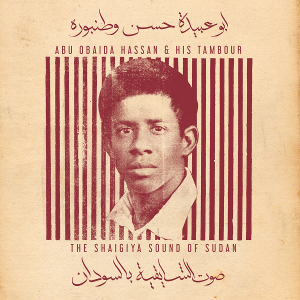
Abu Obaida Hassan & His Tambour - The Shaigiya Sound of Sudan

First published in Songlines Magazine issue 140, August/September 2018.

Abu Obaida Hassan & His Tambour
The Shaigiya Sound of Sudan
Ostinato Records (50 mins)

The Shaigiya people claim lineage from the Arabian Peninsula but grew as a culture in Nubia. The music of the Shaigiya thus has its roots in both places: the melodies use the five-note scales of the south alongside melismas and ornaments of the north, and the rhythms come from all over north-east Africa.

Ostinato Records, fresh from their Grammy-nominated Somali compilation Sweet as Broken Dates, journeyed to Sudan to dig out recordings from Shaigiya master musician Abu Obaida Hassan. He’d become a legend. His music had filled dancefloors in the 1970s but lately was assumed long-dead. Actually, he was just living quietly on the outskirts of Omdurman, and was so enthused by this project that he helped curate this collection personally.

It’s easy to hear how his music captured hearts and bodies in the clubs. With Hassan’s traditional Shaigiya tambour (lyre) – updated by his own hand with extra strings and electronics – backing his voice and only accompanied by drums and chorus, it’s amazing how funky it can be. Catchy, too: the stand-out track ‘La…La’ will have you la’ing along for days after.

Sunday, 18 May 2014

Amira Kheir - Alsahraa

First published in fRoots issue 372, June 2014


Amira Kheir
Alsahraa
Sterns Music (52 mins)

As a Sudanese-Italian living in London, Amira Kheir takes influence from many different cultures and musical styles. In her debut album View from Somewhere, she dotted between Sudanese traditional, Arabic classical music, jazz, soul and even hints of pop music and sang in three different languages.

However, in her second album, Alsahraa (meaning 'the desert'), Kheir shows an increasing maturity and decisiveness in her sound. Fewer genres are blended here – the main attention is to the melding of Sudanese music with soft jazz – and she only sings in Arabic and Italian. As a result, the album feels much more focussed; with a more concentrated style, the tracks of this album blend very well, often leading to the sensation of an overall flow underneath the album.

The high points of Alsahraa come when Kheir is at her most contemplative, such as the tracks 'Ma’assalama Rafiqi', a duet with Senegalese singer Abdoulaye Samb, and 'Fil Teyf', a quiet number backed only by the oud. A more up-tempo highlight is the bossa-inspired celebration of womankind, 'Ya Mara'. The album also contains some exciting instrumental interplay: an interesting relationship is formed between Kheir’s smooth and floating voice and the double bass of Michele Montolli, each seeming to compliment the other perfectly, the individual timbres being almost equal yet opposite.

The overall smoothness of the album can at times lead to it feeling rather bland, though. Through the length of the album, the tracks always feel as if they’re leading up to an explosive finish that never quite comes. But if you have a read of Kheir’s intentions for the album, it begins to make sense. The aim of the album is to make the listener feel ‘overwhelmed in the barren landscape of the desert’…and when you think of it that way, the unrelenting smoothness seems to portray the undulating dunes and oppressive yet beautiful silence of an empty desert.