First published in Songlines Magazine issue 167, May 2021.
Paul F. Berliner
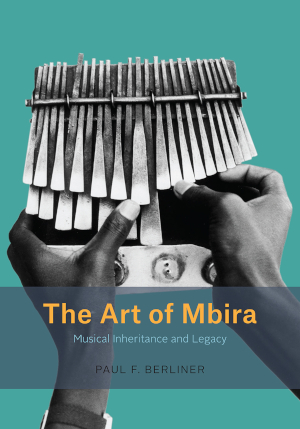
The Art of Mbira: Musical Inheritance and Legacy
The University of Chicago Press (608 pages)
At its heart, this book began in 1971, when Paul Berliner first met mbira player Cosmas Magaya and started a life-long friendship. Such a long-standing relationship gives Berliner and Magaya insights into the mbira that can only have developed through decades of deep thought, matured through constant conversation and mediation. Berliner uses Magaya’s performances to explain the intricacies of mbira playing: how pieces are composed and evolve over time; how the rhythms, harmonies, melodies and texture work together to create a complex and unique musical style; how players vary, improvise, create and recreate mbira pieces and parts; and how the tradition is taught and learnt. Magaya’s presence here is all-encompassing and indelible, arguably deserving a co-author’s credit. His death in July 2020, just months after publication, adds a poignancy to his quote in the book’s introduction: ‘Once we’ve completed this study on behalf of our late mbira-playing comrades – leaving it for others who come behind us – I will know that if I die tomorrow, I can go to my grave satisfied.’
This book really is a monster tome, with over 600 (large) pages and 300 musical examples – and on top of that, there’s a whole website with hundreds of recordings cross-referenced with the text, and an even larger companion book, Mbira’s Restless Dance (912 pages!), with over 500 transcriptions of mbira music. It’s a multimedia magnum opus, and it’s a lot to get through.
The Art of Mbira is a landmark work that will be indispensable for scholars of mbira, Zimbabwean music, music pedagogy, music psychology and for ethnomusicologists and musicologists alike; it will also be a boon to budding mbira players. It’s worth bearing in mind though: this isn’t a book for light reading. It can get very technical and, although Berliner has a knack for evocative description, the academic discussion can be dry verging on impassable. This is an incredible book, and the culmination of two lifetimes of work, but proceed with caution.
This blog is a compendium of my music writing throughout the years. I try to post updates about a month after first publication, but I'm often very behind - please bear with me!
Showing posts with label Ethnomusicology. Show all posts
Friday, 9 April 2021
Friday, 14 June 2019
Reclaiming a Lost Culture That Lives on in Memories
First published in Songlines Magazine issue 149, July 2019.
All across the world, the spectre of colonialism and racism has never stopped casting its long and oppressive shadow. It shows itself in modern-day economics, politics, language and religion; it also affects cultural life and infiltrates itself into the communal memories of the people. An exhibition due to open at SOAS, University of London, in July explores these notions and helps people to reclaim the culture that was denied them. Entitled Stolen Moments – Namibian Music History Untold (1950s-80s), the exhibition focuses on the pop music of Namibia under apartheid rule, through the eyes and ears of the musicians and the listening public.
The project was conceived after documentarian Thorsten Schütte stumbling upon a never-released record by Ben Molatzi in the archives of the Namibian Broadcasting Corporation that sounded like nothing coming out of the country today. After connecting with scholar Aino Moongo and broadcaster Baby Doeseb, the trio dug up similar recordings as well as hundreds of photographs documenting this era when of musical life had been forbidden or persecuted. “We thought, the materials are so colourful and so rich, let’s share it with the local public,” says Schutte, “let’s see how far we can go.”
After placing a request for more information in national newspapers, they received over 1000 phone calls, eventually collecting hundreds of hours of interviews with people of all generations – the oldest interviewee was 106 years old. “We went there to talk about pop and how popular music was established in Namibia, and what we found was how strongly it was connected to the lives and times of the people.”
The exhibition has previously garnered acclaim during spells in Germany and Switzerland, and is raising funds to allow it to be permanently – and publicly – housed in the Namibian capital of Windheok; the digitised materials have already been shared with the national archive.
Dr Angela Impey of the music department at SOAS says “I am thrilled to be hosting this important exhibition at SOAS. Its focus speaks to SOAS Music's priority to engage with marginalised people and to better understand how music is used to define and defend interests. Stolen Moments offers a unique insight into the sounds and stories of remarkably resilient people.” A programme of events will take place alongside the exhibition, including panel discussions on the role of culture inside and outside Namibia at that time, and guided tours by Moongo and Schütte.
The importance of the exhibition and its aim of reviving hidden music and memories is summed up by Moongo: “this beautiful music exists with a liveliness as if it had never stopped playing. You only have to dig for it. It is still there in the minds of the few who can remember, it is still there with the ones who played it and it is still there on those rare recordings that have survived in archives and record collections scattered all around the globe.”
Photo: Namibian worshippers record the sermon of an evangelist onto tape from boom boxes, by John Liebenberg.
All across the world, the spectre of colonialism and racism has never stopped casting its long and oppressive shadow. It shows itself in modern-day economics, politics, language and religion; it also affects cultural life and infiltrates itself into the communal memories of the people. An exhibition due to open at SOAS, University of London, in July explores these notions and helps people to reclaim the culture that was denied them. Entitled Stolen Moments – Namibian Music History Untold (1950s-80s), the exhibition focuses on the pop music of Namibia under apartheid rule, through the eyes and ears of the musicians and the listening public.
The project was conceived after documentarian Thorsten Schütte stumbling upon a never-released record by Ben Molatzi in the archives of the Namibian Broadcasting Corporation that sounded like nothing coming out of the country today. After connecting with scholar Aino Moongo and broadcaster Baby Doeseb, the trio dug up similar recordings as well as hundreds of photographs documenting this era when of musical life had been forbidden or persecuted. “We thought, the materials are so colourful and so rich, let’s share it with the local public,” says Schutte, “let’s see how far we can go.”
After placing a request for more information in national newspapers, they received over 1000 phone calls, eventually collecting hundreds of hours of interviews with people of all generations – the oldest interviewee was 106 years old. “We went there to talk about pop and how popular music was established in Namibia, and what we found was how strongly it was connected to the lives and times of the people.”
The exhibition has previously garnered acclaim during spells in Germany and Switzerland, and is raising funds to allow it to be permanently – and publicly – housed in the Namibian capital of Windheok; the digitised materials have already been shared with the national archive.
Dr Angela Impey of the music department at SOAS says “I am thrilled to be hosting this important exhibition at SOAS. Its focus speaks to SOAS Music's priority to engage with marginalised people and to better understand how music is used to define and defend interests. Stolen Moments offers a unique insight into the sounds and stories of remarkably resilient people.” A programme of events will take place alongside the exhibition, including panel discussions on the role of culture inside and outside Namibia at that time, and guided tours by Moongo and Schütte.
The importance of the exhibition and its aim of reviving hidden music and memories is summed up by Moongo: “this beautiful music exists with a liveliness as if it had never stopped playing. You only have to dig for it. It is still there in the minds of the few who can remember, it is still there with the ones who played it and it is still there on those rare recordings that have survived in archives and record collections scattered all around the globe.”
Photo: Namibian worshippers record the sermon of an evangelist onto tape from boom boxes, by John Liebenberg.
Friday, 12 May 2017
Jennifer W. Kyker - Oliver Mtukudzi: Living Tuku Music in Zimbabwe
First published in Songlines Magazine issue 128, June 2017.
Jennifer W. Kyker
Oliver Mtukudzi: Living Tuku Music in Zimbabwe
Indiana University Press (304 pages)
Oliver Mtukudzi – often known simply as ‘Tuku’ – is a living legend of Zimbabwean music, both within the country and out. His unique mix of traditional Shona styles, soul, jive and South African music consistently defies any other categorisation than simply ‘Tuku music’, and his lyrics have spoken to the hearts of several generations of listeners in Zimbabwe.
With this book, Kyker gives an account of Mtukudzi’s musical life, but to call it a biography would be misleading. While it does take a mostly chronological journey through Tuku’s story, it uses his life and music as a jumping-off point to talk about the role of music across various facets of Zimbabwean social life and history.
The major theme of Living Tuku Music in Zimbabwe is the Shona concept of hunhu – the idea of personal identity based on communality and constant renegotiation, or in Tuku’s words, “being a person among others”. Due to the depth and poetry of Tuku’s music and lyrics, his songs can be interpreted in a multitude of ways, often leading to different groups taking away different messages, even if they are the opposite to Tuku’s stated intent. As such, each chapter focuses on a specific topic (such as politics, HIV/AIDS, the Zimbabwean diaspora), which is then viewed through the dual lens of Mtukudzi’s songs and his audiences’ interpretations of them, demonstrating the hunhu inherent in his music.
As an essentially ethnomusicological text, the theoretical extrapolations and dense technical language may be off-putting for some readers, but there isn’t too much of this to render it completely opaque. Scattered throughout are plentiful lyrics, interviews, photographs and other assorted miscellanea, which provide nice breaks in the wall of words. This is a work that has been in the making for 13 years (including nine years of research), and Kyker has created a thoroughly fascinating book.
Jennifer W. Kyker
Oliver Mtukudzi: Living Tuku Music in Zimbabwe
Indiana University Press (304 pages)
Oliver Mtukudzi – often known simply as ‘Tuku’ – is a living legend of Zimbabwean music, both within the country and out. His unique mix of traditional Shona styles, soul, jive and South African music consistently defies any other categorisation than simply ‘Tuku music’, and his lyrics have spoken to the hearts of several generations of listeners in Zimbabwe.
With this book, Kyker gives an account of Mtukudzi’s musical life, but to call it a biography would be misleading. While it does take a mostly chronological journey through Tuku’s story, it uses his life and music as a jumping-off point to talk about the role of music across various facets of Zimbabwean social life and history.
The major theme of Living Tuku Music in Zimbabwe is the Shona concept of hunhu – the idea of personal identity based on communality and constant renegotiation, or in Tuku’s words, “being a person among others”. Due to the depth and poetry of Tuku’s music and lyrics, his songs can be interpreted in a multitude of ways, often leading to different groups taking away different messages, even if they are the opposite to Tuku’s stated intent. As such, each chapter focuses on a specific topic (such as politics, HIV/AIDS, the Zimbabwean diaspora), which is then viewed through the dual lens of Mtukudzi’s songs and his audiences’ interpretations of them, demonstrating the hunhu inherent in his music.
As an essentially ethnomusicological text, the theoretical extrapolations and dense technical language may be off-putting for some readers, but there isn’t too much of this to render it completely opaque. Scattered throughout are plentiful lyrics, interviews, photographs and other assorted miscellanea, which provide nice breaks in the wall of words. This is a work that has been in the making for 13 years (including nine years of research), and Kyker has created a thoroughly fascinating book.
Sunday, 16 November 2014
Jan Fairley - Living Politics, Making Music: The Writings of Jan Fairley
First published in fRoots issue 378, December 2014
Jan Fairley
Living Politics, Making Music: The Writings of Jan Fairley
Edited by Simon Frith, Stan Rijven and Ian Christie
Ashgate (218 pages)
In 2012, world music lost one of its greatest writers. Even before the term ‘world music’ was coined, Jan Fairley was writing about the music that she loved, regardless of their place or time. Living Politics, Making Music has been compiled from Fairley’s works spanning 28 years (1984 to 2012) and it serves as a great tribute.
Although this book is presented as an academic work (and with a price that would indicate the same – hardback copies are on sale for £100 or more), the collection features writings from popular journals, such as fRoots and Songlines, as well as more scholarly publications. Fairley’s writing is a good mix of the two – the more academic-leaning texts do not approach the dryness that other ethnomusicologists seem unable to escape, and the more popular articles contain an impressive depth in their brevity.
The book is divided into sections, for each of the areas Fairley covered most extensively: writings on Chile; discussions of ‘world music’; writings on Cuba, and a selection of artist interviews conducted for fRoots. The eclecticism of Fairley’s topics is also very impressive – although she mainly examines Latin American styles, she writes with equal authority, passion and imagination on topics of folk, classical or pop music, of the meanings of dance, the mechanics of radio or the workings of the music business.
This book isn’t just useful as a tribute to a great writer, it also genuinely works well along a theme. The chapters are compiled in a way that leads the reader through the most important points about music and politics in Latin America, and the role that world music and ethnomusicology can play in both. In the end, readers will no doubt be enlightened on the subjects that Fairley so eloquently explained, through a book that highlights, if it were needed, what a loss Jan’s was to the world music scene.
Jan Fairley
Living Politics, Making Music: The Writings of Jan Fairley
Edited by Simon Frith, Stan Rijven and Ian Christie
Ashgate (218 pages)
In 2012, world music lost one of its greatest writers. Even before the term ‘world music’ was coined, Jan Fairley was writing about the music that she loved, regardless of their place or time. Living Politics, Making Music has been compiled from Fairley’s works spanning 28 years (1984 to 2012) and it serves as a great tribute.
Although this book is presented as an academic work (and with a price that would indicate the same – hardback copies are on sale for £100 or more), the collection features writings from popular journals, such as fRoots and Songlines, as well as more scholarly publications. Fairley’s writing is a good mix of the two – the more academic-leaning texts do not approach the dryness that other ethnomusicologists seem unable to escape, and the more popular articles contain an impressive depth in their brevity.
The book is divided into sections, for each of the areas Fairley covered most extensively: writings on Chile; discussions of ‘world music’; writings on Cuba, and a selection of artist interviews conducted for fRoots. The eclecticism of Fairley’s topics is also very impressive – although she mainly examines Latin American styles, she writes with equal authority, passion and imagination on topics of folk, classical or pop music, of the meanings of dance, the mechanics of radio or the workings of the music business.
This book isn’t just useful as a tribute to a great writer, it also genuinely works well along a theme. The chapters are compiled in a way that leads the reader through the most important points about music and politics in Latin America, and the role that world music and ethnomusicology can play in both. In the end, readers will no doubt be enlightened on the subjects that Fairley so eloquently explained, through a book that highlights, if it were needed, what a loss Jan’s was to the world music scene.
Labels:
Book Review,
Ethnomusicology,
fRoots,
UK
Subscribe to:
Posts (Atom)

