First published in Songlines Magazine issue 140, August/September 2018.
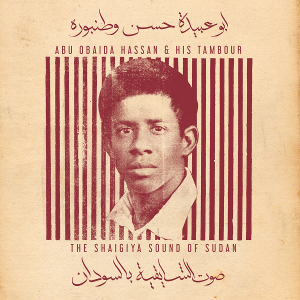
Abu Obaida Hassan & His Tambour
The Shaigiya Sound of Sudan
Ostinato Records (50 mins)
The Shaigiya people claim lineage from the Arabian Peninsula but grew as a culture in Nubia. The music of the Shaigiya thus has its roots in both places: the melodies use the five-note scales of the south alongside melismas and ornaments of the north, and the rhythms come from all over north-east Africa.
Ostinato Records, fresh from their Grammy-nominated Somali compilation Sweet as Broken Dates, journeyed to Sudan to dig out recordings from Shaigiya master musician Abu Obaida Hassan. He’d become a legend. His music had filled dancefloors in the 1970s but lately was assumed long-dead. Actually, he was just living quietly on the outskirts of Omdurman, and was so enthused by this project that he helped curate this collection personally.
It’s easy to hear how his music captured hearts and bodies in the clubs. With Hassan’s traditional Shaigiya tambour (lyre) – updated by his own hand with extra strings and electronics – backing his voice and only accompanied by drums and chorus, it’s amazing how funky it can be. Catchy, too: the stand-out track ‘La…La’ will have you la’ing along for days after.
This blog is a compendium of my music writing throughout the years. I try to post updates about a month after first publication, but I'm often very behind - please bear with me!
Friday, 13 July 2018
Sunday, 1 July 2018
Diving Into Somali Arts with Numbi

Because this website is nominally a blog, maybe it’s time for me to write a blog? Or give it a try at least, let’s see how it goes. I thought I’d give a bit of an update on a thread that’s been going through my life lately.
As you may know, I am currently studying an MMus Ethnomusicology. I’m doing it all in one year and I started back in September, so it feels like the home stretch at the moment, but I still have the biggest hurdle to clear first, writing my dissertation. My subject is something I’ve had an interest in for a few years but I’ve never really been able to delve into it like I wanted to, so this seemed like a good opportunity. I’m looking at Somali music, or, more specifically, what music means to Somali people in the UK. I’m learning so much (as you’d hope), and it’s really exciting to engage with so many people with interesting ideas to share.
One particular organisation that has been invaluable to me so far, and is really doing stunning work, is Numbi Arts. When you know that Numbi is the name of both a traditional Somali healing dance and also the last feature film made in Mogadishu before the devastating civil war, you can kind of see where they’re coming from. Numbi Arts is an organisation in Tower Hamlets (based out of the wonderful Rich Mix, actually), where there has historically been a significant Somali population and looks at art as a way for people to engage with their community and their identity, their history and their future.
I’ve been to two events run by Numbi so far. The first one was back in February, actually at Rich Mix. It was rather gloriously chaotic. As far as I can tell, it was the first event of the new ‘season’ for Numbi, and so the projects featured were perhaps works-in-progress leading up to the big festival in July (more about that in a little bit). But despite some rough edges, it was a load of fun. The theme for the day was Coming Here, Being Here, and that was reflected in an emphasis on kids and their connections with their families, with London and with their links to East Africa. The highlight for me was a lovely little film by Salma Bihi, interviewing her mother about her memories of Somalia, the journey to the UK and her life here. It was really well made, and provided insights for us in the audience and Bihi herself. It complemented the rest of the programme well, too, which included poetry from kids with a helping hand from Sai Murray and Mr Gee (yeah, the same Mr Gee from the Russell Brand radio shows), a short podcast and a collective creative writing exercise. After a hearty meal (it’s always good to have a meal, right?), the event came to a close with some music led by Mohamed Maalow Nuur, who in his time was a member of at least two of the most iconic ‘golden era’ bands, Waaberi and Iftiin. With oud and bongos, and vocals provided by as many people as knew the words, the music served well to accompany a troupe of Somali dancers (you can see them on the left, there). I really don’t know much about dancing at all, and it was the first time I’d ever encountered Somali dance, but it looked good to me!
After having a really nice time at that first event, I got in touch with Kinsi Abdulleh. She runs Numbi and her passion is obvious and really inspiring. She’s an artist, first and foremost, and I think that comes across in her work. She’s not about the standard way of doing things, she likes to mix things up. Do them in a different way to get reactions that would otherwise remain hidden. Make it weird, a bit. Who else would think to work on community engagement in Tower Hamlets by arranging a yoga retreat in Gambia? We had a great conversation about all sorts of things, and I was delighted to be invited to an event co-hosted by Numbi and the British Library, called A Postcard from London, which happened just last weekend.
It was a much smaller event than in Rich Mix, with about 20 participants as opposed to the maybe couple of hundred in February. This was on purpose – it is a library, after all – but it really lent an intimate vibe to everything, and we all got to know each other a little bit, which was nice. The day started with a small tour of the library’s treasures. Unfortunately, the Library gave the task of tour guide to possibly the most boring man who worked there, and he somehow managed to make some really interesting stuff impossibly dull. But hey-ho. After that we got to what we were actually there for.
The first half of the workshop was curated by the Library’s Somali Collections Project Officer, Mahamad Ali, and it allowed us to take a small dive into the history of written Somali literature in English, Arabic and (after 1972) Somali. There was all sorts: poetry, novels, political pieces and academic writing, even some interesting, albeit rather distasteful, colonial works. What piqued my interest the most, though, wasn’t a book at all, but a long wooden board, covered in hand-inked Arabic (pictured right). One of the participants, a wonderful gentleman called Mr Ali Ahmed Hussein, who used to be the director of the National Museum of Somalia and was a font of knowledge throughout the day, explained to us that this was part of a Qur’an. It was a teaching tool: children were taught the Qur’an and how to write Arabic at the same time. They wrote out each Surah over and over until their penmanship was perfect and they had it memorised by heart. Each time they wrote it out, the board was washed, dried and used again.
Another element that was presented was a Somali philatelic collection…or, to you or me, a bunch of stamps. Surprisingly engaging, actually! They covered a big range of history and subjects, from architecture, art and dance, to denouncing apartheid and celebrating the Somali language and the Arab League. There were stamps from various iterations of independent Somalia, and of the colonial territories of Somaliland and Jubaland, and even a stamp representing Somali refugees. The details on these tiny stamps were impressive. This formed the seed of our workshop: we got a big bunch of photocopied stamps to chop up and remix into what we related to Somalia, and maybe even write them as if a postcard. I have never been one gifted in the visual arts, so mine was a rather feeble offering, but there was some wild creations. Most fun for me was getting to mill about, looking at everyone’s artistic efforts and having some really insightful chats.
After both of these events, I’m getting excited for the next one, it’s just around the corner! Numbi Arts host a festival each year, and each year has a different theme and focus city. Usually the city is in Somalia, but this year the focus is London, and the theme is Repair and Rebellion. This means the focus is very much on diaspora, and allowing people to negotiate and contest their experiences and opinions of being part of a diaspora through different artistic formats and cultural practices, including oral and written language, music, dance, film and theatrical performances as individuals and as groups. The festival will feature many different aspects and events including site-specific installations, an open archive, a mobile recording studio, documentation sites and intergenerational conversation.
The first event will be held at Rich Mix on 21 July to launch the festival, where Numbi will share all the interesting items in their own archival collection and encourage people to add to it themselves with workshops in smartphone storytelling and studio portraiture. After will be an evening of poetry (Somalia is well-known for being a country of poets) and music, again from Mohamed Maalow Nuur. Perhaps the most exciting for me is the big finale of this opening event: a conceptual music and spoken word tribute to Poly Styrene. She was best known as the frontwoman of the punk band X-Ray Spex, and also half-Somali. Her daughter, Celeste Bell, is also a musician and a film-maker; she’s currently making a film about her mother and will be helping to organise this tribute. Who knows, maybe we will get some Somali-flavoured punk going on? Perhaps I should bring my saxophone…
So, that’s it I guess. If you’re in London, you know where I will be on 21 July, you should come in and join the festivities! You can get your tickets here. See you then!
Friday, 15 June 2018
Spotlight: Analog Africa & Samy Ben Redjeb
First published in Songlines Magazine issue 139, July 2018.
An iconic record label needs a signature sound, a unifying element that makes all its releases stand out as its own. Analog Africa undoubtedly has that. Its records are unmistakable, whether they’re from Cameroon, Cape Verde or Colombia. They all have that distinctive blend of funk, soul and local traditions with a gloriously chaotic analogue charm – Analog Africa’s records always represent the epitome of African groove.
It’s all down to a man with impeccable taste and a ridiculous travel schedule. Samy Ben Redjeb crafts each album himself, from the sequencing and licencing to writing the sleeve notes. His gift for curation has its roots in his teenage years in Tunisia. “When I was working in bakeries and coffee shops, I made mixtapes. I drew the cover myself and I would earn maybe 10 cents a cassette. That taught me how to combine the songs so they flowed nicely together. I think that was the beginning.”
He went on to be a diving instructor, a hotel DJ, an airline steward…anything that allowed him to travel (and listen) widely. Time in Senegal opened his ears to the world of Sub-Saharan music, and he ended up hopping the continent at every opportunity, gathering experiences and records at every stop. It’s a habit he keeps to this day. While in Zimbabwe, he realised he could give this music the wider audience it deserved. After the first Analog Africa record, by wha-wha band The Green Arrows in 2006, there was no looking back.
Each album explores a scene or artist from anywhere across Africa and Afro-Latin America, but they’re all from the 60s to the 80s, building a snapshot of all things funky in that golden period. What is it about that particular sound that excites Redjeb? There’s a clue in the label’s name: “It’s the quality, the way it was recorded live, the analogue set-up. Often the bands didn’t have so much money; they just didn’t have the equipment. They were doing bricolage. If a valve went in an amp, they wouldn’t have the exact replacement, they would improvise. You don’t know how they made that sound, you can’t recreate it.”
He’s not a rabid crate-digger hunting for only the most obscure artefacts, though. “People think I’m all about the really rare stuff, which is not the criteria at all. Some of the songs I love most have been huge hits. For me, it just has to be interesting. It has to make me curious.” That philosophy extends to his regular Analog Africa DJ sets. The stuff he plays is obviously top-notch, but don’t just expect the back-catalogue: “Generally I play the stuff that I’m going to release. I don’t tend to play much of the music I already have on my label. Just because I heard it so much and I’m tired of it!”
It’s no wonder there’s always another album on the horizon and multiple projects happening at once. There are forthcoming releases from Ghana, Somalia and the Brazilian Amazon, and you just know Redjeb has a million other exciting things up his sleeve. With a sound as recognisable as Analog Africa’s, quality is most definitely assured.
An iconic record label needs a signature sound, a unifying element that makes all its releases stand out as its own. Analog Africa undoubtedly has that. Its records are unmistakable, whether they’re from Cameroon, Cape Verde or Colombia. They all have that distinctive blend of funk, soul and local traditions with a gloriously chaotic analogue charm – Analog Africa’s records always represent the epitome of African groove.
It’s all down to a man with impeccable taste and a ridiculous travel schedule. Samy Ben Redjeb crafts each album himself, from the sequencing and licencing to writing the sleeve notes. His gift for curation has its roots in his teenage years in Tunisia. “When I was working in bakeries and coffee shops, I made mixtapes. I drew the cover myself and I would earn maybe 10 cents a cassette. That taught me how to combine the songs so they flowed nicely together. I think that was the beginning.”
He went on to be a diving instructor, a hotel DJ, an airline steward…anything that allowed him to travel (and listen) widely. Time in Senegal opened his ears to the world of Sub-Saharan music, and he ended up hopping the continent at every opportunity, gathering experiences and records at every stop. It’s a habit he keeps to this day. While in Zimbabwe, he realised he could give this music the wider audience it deserved. After the first Analog Africa record, by wha-wha band The Green Arrows in 2006, there was no looking back.
Each album explores a scene or artist from anywhere across Africa and Afro-Latin America, but they’re all from the 60s to the 80s, building a snapshot of all things funky in that golden period. What is it about that particular sound that excites Redjeb? There’s a clue in the label’s name: “It’s the quality, the way it was recorded live, the analogue set-up. Often the bands didn’t have so much money; they just didn’t have the equipment. They were doing bricolage. If a valve went in an amp, they wouldn’t have the exact replacement, they would improvise. You don’t know how they made that sound, you can’t recreate it.”
He’s not a rabid crate-digger hunting for only the most obscure artefacts, though. “People think I’m all about the really rare stuff, which is not the criteria at all. Some of the songs I love most have been huge hits. For me, it just has to be interesting. It has to make me curious.” That philosophy extends to his regular Analog Africa DJ sets. The stuff he plays is obviously top-notch, but don’t just expect the back-catalogue: “Generally I play the stuff that I’m going to release. I don’t tend to play much of the music I already have on my label. Just because I heard it so much and I’m tired of it!”
It’s no wonder there’s always another album on the horizon and multiple projects happening at once. There are forthcoming releases from Ghana, Somalia and the Brazilian Amazon, and you just know Redjeb has a million other exciting things up his sleeve. With a sound as recognisable as Analog Africa’s, quality is most definitely assured.
Invisible System - Bamako Sessions
First published in Songlines Magazine issue 139, July 2018.
Invisible System
Bamako Sessions
Riverboat Records (52 mins)
Invisible System, aka producer and multi-instrumentalist Dan Harper, is best known for his heavy dub-rock takes on Ethiopian music, drafting in huge names such as Mahmoud Ahmed, Justin Adams and Juldeh Camara.
For this album, Harper used his usual technique: set up a studio, bring in a rotating cast of local musicians to jam, and dub the results. This time though, he’s back in Mali, where he made his first recordings back in 1999. His guests are solid as always – Songhai bluesman Sidi Touré is probably the best-known and provides some cool guitar parts – and kora, balafon and ngoni are all well represented. It’s all instrumental and all improvised.
Malian dubtronic fusions are not exactly new, and Bamako Sessions just isn’t as adventurous as some of Harper’s earlier work, especially 2009’s fantastic Punt. The tracks all sound basically similar and a little repetitive; there’s no psychedelic dub-outs, it’s all rather low-key. There’s nothing bad about it, but there’s nothing exciting either. Invisible System has proved capable of making intense and interesting fusions, so it’s disappointing to hear an average album in a style where other artists have flourished in the past.
Invisible System
Bamako Sessions
Riverboat Records (52 mins)
Invisible System, aka producer and multi-instrumentalist Dan Harper, is best known for his heavy dub-rock takes on Ethiopian music, drafting in huge names such as Mahmoud Ahmed, Justin Adams and Juldeh Camara.
For this album, Harper used his usual technique: set up a studio, bring in a rotating cast of local musicians to jam, and dub the results. This time though, he’s back in Mali, where he made his first recordings back in 1999. His guests are solid as always – Songhai bluesman Sidi Touré is probably the best-known and provides some cool guitar parts – and kora, balafon and ngoni are all well represented. It’s all instrumental and all improvised.
Malian dubtronic fusions are not exactly new, and Bamako Sessions just isn’t as adventurous as some of Harper’s earlier work, especially 2009’s fantastic Punt. The tracks all sound basically similar and a little repetitive; there’s no psychedelic dub-outs, it’s all rather low-key. There’s nothing bad about it, but there’s nothing exciting either. Invisible System has proved capable of making intense and interesting fusions, so it’s disappointing to hear an average album in a style where other artists have flourished in the past.
Thursday, 10 May 2018
Introducing The Turbans
First published in Songlines Magazine issue 138, June 2018.
The Turbans are many. Many members, many homelands, many instruments and many styles, all together as one. They are a band of stories: theirs started when two half-Iranian musicians, Oshan Mahoney and Darius Luke Thompson, met while cycling in Nepal. They started jamming and busking together as they travelled and found new musical friends as they made their way through the subcontinent, forming the foundations of The Turbans.
They accrete as they go. There are Turbans everywhere now: if the band’s seven-member nucleus goes to Thailand, or Mexico, or Australia, there are people who are ready to hop seamlessly into the line-up. No-one knows how many of them there are, but Oshan reckons there’s about 40 of the buggers. As band legend has it, “at any given time, there’s a member of the Turbans playing music somewhere in the world.”
They all have an interesting and unlikely story to tell. Maxim Shchedrovitzki was born in Belarus, raised in Israel and learnt the Turkish oud in India; Miroslav Morski is well-known as a pop singer in Bulgaria; bassist Freddie Stitz was in Razorlight. The list goes on. Unfortunately, their whole story is so epic that they’d need a feature film to explain fully. “We have our silly answer to ‘Where are you from,’” says Oshan, “we just say ‘Manywhere’. We throw it away really, because it’s a story, it takes time, and that’s a shame.”
The music is just as international. Their sound is situated somewhere between Eastern Europe and the Middle East. Turkish folk melodies pop up in klezmer tunes and Bulgarian choirs sing to classical Arabic maqamat. It goes further too: there’s plenty of flavours hinting at everywhere from Albania to India. So how do they stop it from sounding like just a million different sounds? Says Maxim: “It is a million different sounds though!” Oh. “But oftentimes we find that this little part of an Indian raga is just like they play it in Morocco, it’s so similar. Then suddenly you have a composition which is Indo-Moroccan.” Oshan interjects, “so really, in the end it’s not that difficult, actually. Because it’s not actually different types of music, it’s just the same one that’s split into different time-zones.” Maxim jumps back in: "And what makes it sound like us is, I think, deep down we’re all rockers. We like to bang it!"
What’s surprising is that they’re not necessarily a party band. They can party (hard!) but their music has a subtlety that’s rare in other bands of similarly diverse influences. The crashing cymbals and oompahs will get you up and stomping about, but there is always intricacy there when you look for it and their quieter moments are extra special.
After years of performing across the globe, they’ve finally made a record. Their self-titled debut album has just been released, and of course there are many stories attached to its whenceabouts. They will regale you if you ask, but it’s really all there in the music. The Turbans are a band of stories. They come from manywhere but their music is definitely from here…wherever that happens to be today.
Photo: The Turbans live at the Islington Assembly Hall, by Ilka Schlockermann.
The Turbans are many. Many members, many homelands, many instruments and many styles, all together as one. They are a band of stories: theirs started when two half-Iranian musicians, Oshan Mahoney and Darius Luke Thompson, met while cycling in Nepal. They started jamming and busking together as they travelled and found new musical friends as they made their way through the subcontinent, forming the foundations of The Turbans.
They accrete as they go. There are Turbans everywhere now: if the band’s seven-member nucleus goes to Thailand, or Mexico, or Australia, there are people who are ready to hop seamlessly into the line-up. No-one knows how many of them there are, but Oshan reckons there’s about 40 of the buggers. As band legend has it, “at any given time, there’s a member of the Turbans playing music somewhere in the world.”
They all have an interesting and unlikely story to tell. Maxim Shchedrovitzki was born in Belarus, raised in Israel and learnt the Turkish oud in India; Miroslav Morski is well-known as a pop singer in Bulgaria; bassist Freddie Stitz was in Razorlight. The list goes on. Unfortunately, their whole story is so epic that they’d need a feature film to explain fully. “We have our silly answer to ‘Where are you from,’” says Oshan, “we just say ‘Manywhere’. We throw it away really, because it’s a story, it takes time, and that’s a shame.”
The music is just as international. Their sound is situated somewhere between Eastern Europe and the Middle East. Turkish folk melodies pop up in klezmer tunes and Bulgarian choirs sing to classical Arabic maqamat. It goes further too: there’s plenty of flavours hinting at everywhere from Albania to India. So how do they stop it from sounding like just a million different sounds? Says Maxim: “It is a million different sounds though!” Oh. “But oftentimes we find that this little part of an Indian raga is just like they play it in Morocco, it’s so similar. Then suddenly you have a composition which is Indo-Moroccan.” Oshan interjects, “so really, in the end it’s not that difficult, actually. Because it’s not actually different types of music, it’s just the same one that’s split into different time-zones.” Maxim jumps back in: "And what makes it sound like us is, I think, deep down we’re all rockers. We like to bang it!"
What’s surprising is that they’re not necessarily a party band. They can party (hard!) but their music has a subtlety that’s rare in other bands of similarly diverse influences. The crashing cymbals and oompahs will get you up and stomping about, but there is always intricacy there when you look for it and their quieter moments are extra special.
After years of performing across the globe, they’ve finally made a record. Their self-titled debut album has just been released, and of course there are many stories attached to its whenceabouts. They will regale you if you ask, but it’s really all there in the music. The Turbans are a band of stories. They come from manywhere but their music is definitely from here…wherever that happens to be today.
Photo: The Turbans live at the Islington Assembly Hall, by Ilka Schlockermann.
Etenesh Wassie & Mathieu Sourisseau - Yene Alem
First published in Songlines Magazine issue 138, June 2018.
Etenesh Wassie & Mathieu Sourisseau Yene Alem Buda Musique (43 mins) The collaboration between Ethiopian singer Etenesh Wassie and French bass guitarist Mathieu Sourisseau has already yielded one album back in 2010 and now they’ve brought along cellist Julie Läderach (also French) to join them on their journey. This is art music, and as such it benefits from concentrated listening. The interplay between voice, cello and bass creates an atmosphere that is stark yet intimate, and always intense. It’s serious stuff, but that’s not to say it’s inward-looking. The soundsculpture of Yene Alem is one that mixes classical and folk music of Europe with avant-garde rock and free jazz and always works in complete sympathy with the age-old qañat scales and melodies of Ethiopia’s azmari bards. The trio get funky when they need to, but they’re not afraid to unsettle your ears, either. The size and make-up of the ensemble doesn’t really give too much scope for variation in texture - a range of electronic effects on Sourisseau’s acoustic bass notwithstanding – and by the end of the album you may want something a bit different. More contrasts would be welcome, I think, but that shouldn’t take away from the otherwise very nourishing music: this is food for the ears and the mind.
Gitkin - 5 Star Motel
First published in Songlines Magazine issue 138, June 2018.
Gitkin 5 Star Motel Wonderwheel Recordings (42 mins) It’s hard to find out anything about Gitkin. It appears that this is the almost-one-man-band’s debut record, and the press information doesn’t shed too much light besides its story: 5 Star Motel is a concept album of sorts, supposedly inspired by Gitkin’s mysterious US-travelling, bootleg-guitar-selling, possibly part-mythical uncle. If, like me, that brings you to expect an Americana fest full of lonely highways, you’re in for a surprise. At the heart of it, 5 Star Motel is an instrumental album rooted in psychedelic surf rock, but its branches reach much further. The opening track starts with a guitar in the style of an Arabic qanun (zither) and, from there, influences abound from Greece, Turkey, Ethiopia, Mali, Nigeria, Peru, Cuba, Jamaica and probably elsewhere. There’s lounge jazz, synth-pop and folk baroque in there, and, okay, there’s some Americana too. When so many diverse flavours are crammed into one album, the results are usually incoherent and forced, but not here: Gitkin manages it with an uncommon subtlety. All those international melodies and rhythms fit into each other with ease, and all with a healthy drenching of reverb and echo straight out of the 1960s. This is an unexpected delight – so listen without expectation!
Subscribe to:
Posts (Atom)


