Friday, 12 May 2023

Bored Drummers - Songlines Soapbox

First published in Songlines Magazine issue 188, June 2023.


Drummers: we love ‘em. They are – quite literally – the heartbeat of much of the world's music, whether they’re holding down an ensemble in a groove or whipping up the audience with a frenzied battery. There are few more intoxicating experiences than those led by polyrhythms blasted from drum-skins, and for that, drummers, we humbly thank you. But over the past decade or so, I’ve slowly become aware of an on-going epidemic that is sweeping the rhythmic community with frightening effect… I'm talking of course about the plight of Bored Drummers in Quiet Sections of Concerts. It really is a worrying trend. The most easily infected are kit drummers who play in bands, but players of single drums and percussion sets are definitely not immune.

You may have noticed some of the symptoms yourself. They manifest whenever the tempo slows and the ensemble quietens to a hush; maybe it’s during a subdued solo, an introductory a cappella section, or perhaps a stripped back mid-piece breakdown that renders a drummer's usual soundcraft unsuitable. Without a strong pulse to solidify, the drummer starts to get bored and, in an effort to keep their attention on the job at hand, they start to make vague, indistinct noises with their kit or whatever they have close to hand. The first indications of the Bored Drummer are fairly basic and innocuous: rumbling on the tom-toms, using soft beaters to create a wash of cymbals (the more bored the drummer, the more cymbals are involved; bonus points if they’ve managed to sneak a gong onto the stage), or tinkling on a strategically placed set of chimes.

But from those initial inklings of the condition, the possibilities are endless. It can take many eclectic and eccentric forms. Anything that can make an interesting yet still essentially non-descript sound is fair game: cowrie shells are rattled, spring-based contraptions are used to imitate thunder, cymbals are sounded with violin bows, all manner of rainsticks, maracas and home-made bell trees are shaken… I’ve even encountered musicians picking up and dropping heavy chains just to have something to do. The really out-there go so far as to entertain themselves with unpitched wind instruments such as conches, bullroarers and whirly-tubes. Maybe you haven’t noticed this habit yet, but you will now I’ve mentioned it. And you’ll notice it every single time it happens.

Where does this strange phenomenon come from? I guess it’s rooted in the big Late Romantic orchestras with their huge percussion sections – the composers needed to entertain their musicians through multi-hour works, and so littered them with frequent timpani rolls and cymbal crashes. But I think this current strain dates back to small-band jazz. In the early days, jazz drummers could get away with shuffling on a snare with brushes in the quiet bits, but eventually the long ballads and unmetered solo sections of more progressive styles rendered the drummers’ keen technical abilities temporarily surplus to requirements. From there, the boredom only increased, and the phenomenon of random percussive twiddling started to spread.

“It adds atmosphere!” the drummers will no doubt be quick to plead, from all the way back there on their little platforms. And sometimes it does, if their contributions are subtle enough, employed sparingly and judiciously by thoughtful and skilled musicians. But that’s not usually the case, is it? More often than not, it offers little more than vague, contextless white noise that – if anything – gets in the way of whatever atmosphere is being created, especially if the audience’s attention is diverted from that atmosphere towards the ostentatious percussion the drummer is now brandishing.

I’m sure you’ll agree, the problem of Bored Drummers is clearly a worrying trend. So how can we fix it? Well, some solutions have already begun making their way onto the stage. Lately, some drummers have been given a little keyboard or Kaoss pad, with the task of adding a drone, ostinato or other synthesised atmosphere to these quieter moments. It won’t work in every scenario, but it’s much more welcome than the current state – although it does come with the added danger of allowing a drummer the dangerous capability of full scales. Can you imagine the carnage? God forbid.

Maybe the solution could be to offset the quieter moments with more loud ones. Let’s hear more drum solos! We don’t seem to get as much of these nowadays, and a tasty solo is always fun. If we have more of them, maybe we’ll tire the drummers out so that they won’t need to use their bottled-up Animal-esque energy during the quiet bits. Or maybe we can all chip in and give them all a small handheld games console that they can whip out during more subdued moments to entertain themselves (ideally with headphones attached)? I don’t know.

To any drummers reading – we care about you, we need you and we appreciate your contributions to music all over the world for the past 7,500 years. We want you to be safe, and we don’t want you to be bored. Keep doing what you do best: creating thick topiaries of thumping bombast and crashing cymbal, or else an intricate filigree of complex polyrhythm. And when things slow down and take an introspective turn, put down that extravagant home-made noisemaker or whatever other doohickey you’re reaching for. Let the music breathe and the atmospheric mists rise unmolested by crinkles, rattles or chimes. Don’t get struck down by the Bored Drummers in Quiet Sections of Concerts illness – we’re all here to support you and protect you and keep you doing the Music Gods’ work. Now, we’ll see you next time you’re on stage, and we look forward to hearing your art. Stay well, stay healthy. And maybe you can keep a shaky egg, for very special occasions only.


Photo: Drum kit, by Ewan Topping. Used under licence CC BY 2.0.

Obituary: Emahoy Tsege-Mariam Gebru (1923-2023)

First published in Songlines Magazine issue 188, June 2023.


It’s a rare and beautiful thing to experience an artist whose work is utterly their own, that defies easy comparison or categorisation; to listen to music that one can only meaningfully describe using abstract, effusive terms. That is the music that Emahoy Tsege-Mariam Gebru made when she sat down at her piano.

Her music is a unique style of Ethiopian pianism. It contains depths. The elegant cascades of her piano’s keys call forth memories, histories, influences: Beethoven, Debussy, Art Tatum, Satie, Chopin, Scott Joplin, courtly waltzes, Ethiopian Orthodox chants and folk melodies, the dignified hymns of the giant begena lyre, life’s hardships and joys, her beloved family members, her deep spirituality, her compassion. Her pieces don’t flourish in virtuosity, but precision; masterworks of chiaroscuro, they offer comfort, suspense and surprise. Languid rubato and unexpected turnarounds of tonality make her music drift and flow like heavy frankincense smoke, or a tide, or a waterfall. There is no separating composition from performance, as they are both hers alone.

Emahoy Tsege-Mariam’s life story is just as astonishing. Born Yewubdar Gebru into an important political family in Addis Ababa in 1923, she had a whirlwind of an early life, with time as a schoolgirl in Switzerland, a prisoner-of-war in Italy, and a scholar of European classical violin and piano in Egypt. A promising career beckoned, but Yewubdar’s musical life was abruptly halted when Emperor Selassie refused her permission to continue her studies in England. After falling into depression and illness, faith guided her to sneak away to a monastery in the countryside. By the time she was 25, Yewubdar had become a nun of the Ethiopian Orthodox Church, taking the title of Emahoy and changing her name to Tsege-Mariam.


It was after taking the veil that she created her singular musical style and composed most of her 150-plus works. But the music has always been just one thread in her life’s work of charity. Upon witnessing the homelessness of young people studying at her church, she dedicated herself to the poor and needy. Whenever she recorded her compositions and released albums, she made sure that all the proceeds went directly to orphanages. After several years of working for the Orthodox church in Jerusalem, Tsege-Mariam eventually moved to the Holy City for good in 1984. Living a semi-hermetic life in a monastery, she continued to help the poor in Israel and Ethiopia, continuing to practice piano daily.

It was in these later years that her music started to get the reach and attention it deserved, spearheaded by a compilation of her older recordings as Éthiopiques, Vol. 21 in 2006. The album was a revelation, and gained her fans around the world. Her compositions have been used in various film soundtracks, a documentary about her own life is currently in production, and two more albums of her work are set to be released in 2023 – with all proceeds, as ever, to those in need.

Emahoy Tsege-Mariam Gebru died months short of her 100th birthday. In a review of her latest album, Jerusalem, I wrote that ‘Emahoy Tsege-Mariam is a living musical treasure.’ She may no longer be with us, but the treasure of her music will live for a long time to come.


Photo by kind permission of the Emahoy Tsege Mariam Music Foundation.

Ahl Nana - L'Orchestre National Mauritanien

First published in Songlines Magazine issue 188, June 2023.

Ahl Nana
L'Orchestre National Mauritanien
Radio Martiko (68 mins)

A never-before-released record of a once-famous, almost-forgotten group who were the progenitors of their very own style: this album is a crate-digger’s dream. It’s also a record that might even rewrite music history – label Radio Martiko announces that it ‘mark[s] the birth of the genre that is known in the West as Desert Blues.’

Ahl Nana were some of the first stars of modern music in Mauritania in the 1960s and 70s – a family band from the country’s Arab-Berber population, their music combined traditional Berber styles with modern sensibilities and cosmopolitan influences from across the trans-Saharan trade route. To add to the novelty, they substituted traditional instruments for Western ones: the one-string rababa fiddle became a violin, and the tidinit lute sat alongside electric guitar, with a conga-type drum and tambourine standing in for the tbal (kettle drum) and daghumma (rattle). The songs composed by the group’s violinist, leader and matriarch Debya mint Soueid Bouh became known across the Sahara.

Despite the group’s success, their performances remained the domain of concerts and radio sessions, rather than commercial records. A royal invitation to Morocco finally persuaded the group into the studio in Casablanca in 1971; they had fun, but that was the last they heard of the recordings. Records were pressed but never sold, and the Nana family never even saw a copy until Radio Martiko found some in a Moroccan backroom and arranged this reissue – it’s lucky for us that these recordings are finally reaching ears.

It might be cliché, but this music really does echo the Saharan environment: the guitar is distorted as if its amp is covered in grit, and the heterophonic melodies of the voices, violin and guitar jangle like howling winds. The performances sound informal, as if occurring in a family living room, which gives everything an enjoyable looseness and allows the songs to be expanded up to the ten-minute mark. And yes, sometimes it does sound really bluesy – some of the tracks could definitely host a harmonica solo without anything sounding out of place – but there are surprises, too: the album’s opener is a version of the Bollywood classic ‘Aajkal Tere Mere Pyar Ke Charche’, sung in the original Hindi with a distinctive Saharan edge to its rhythms. The broad international influences, the combination of traditional and contemporary, the radiant cool of it all and the high-quality recording all add up to an album that sounds much more modern than its 1971 creation.

So what about the claim that this is the birth of the ‘desert blues’? Well, that awkward term is always an imposition from a Western perspective – it’s a label that encompasses many different styles from many different cultures, only linked by a passing similarity to the American-born blues. Asking whether something is or is not desert blues is usually the wrong question. Nevertheless, Ahl Nana’s music does seem to have deep resonations throughout Saharan culture. In a fascinating interview included in the album’s sleeve notes, singer Mouna mint Nana mentions that her family’s success influenced other groups to make music that was not only modern and international, but indelibly Mauritanian as well, an aesthetic that spread out across the Sahara. Important and hugely popular musicians such as Tinariwen and Youssou N’Dour took Ahl Nana’s songs into their repertoire, and their own impact has reached around the world.

In the end, issues of rarity and questions of historical impact are all secondary to the music itself. And this music is lovely, made at a crossroads between cultures and between tradition and modernity, and throwing up a unique and sometimes surprising sound that is deeply Saharan. This reissue is an honour to the legacy of Debya mint Soueid Bouh and her family.

Entoto Band - Entoto Band

First published in Songlines Magazine issue 188, June 2023.

Entoto Band
Entoto Band
Guitar Globetrotter Recordings (37 mins)

Entoto Band are a Netherlands-based group directed by guitarist Joep Pelt and fronted by Ethiopian singer Helen Mengistu and Eritrean saxophonist and singer Amanyal ‘Million’ Tewelde. Like so many modern Ethio-jazz groups, they are clearly heavily inspired by the classic, timeless Swinging Addis-era sounds, the distinctive pentatonic melody lines and gently loping rhythms. But Entoto Band make those styles their own with thick layers of heavy, dirty funk (powered by Hammond organ and a meaty synth bass) and more subtle references to Cuban music, soul, dub, Afrobeat and even house music, as well as modern Habesha pop.

The use of instrumentation is particularly impressive here. The six-piece group make deft use of multitracking (multiple synth parts at once; Amanyal’s saxophone and synth-aerophone lines becoming a whole horn section) without taking away from any individual’s effort – everyone gets a chance to shine. The rhythm section of synths-drums-percussion is always tight, and always grooves hard, with enough space for the fireworks of whoever is stepping to the plate next.

Entoto Band’s debut record really serves to underline just how epochal original Ethio-jazz scene was, and just how flexible that style can be, that it can still sound so fresh and exciting in so many different contexts while remaining immediately recognisable.

Dur-Dur Band International - The Berlin Session

First published in Songlines Magazine issue 188, June 2023.

Dur-Dur Band International
The Berlin Session
Outhere Records (37 mins)

In the 1980s, Dur-Dur Band were one of Somalia’s biggest groups, in high demand and performing their uniquely Somali disco in nightclubs and hotels all over the country. But the 90s brought civil war and an oppressive regime, and Dur-Dur’s members scattered across the globe.

Reissues of the band’s classic albums have gained acclaim, but The Berlin Sessions marks their first original release since their split. Sort of. Dur-Dur Band International aren’t the Dur-Dur Band but a Dur-Dur Band, one of multiple rival formations continuing the group’s legacy. This is the UK-based faction, headed by bassist (and the only original member) Cabdillahi Cujeeri. But really, that’s all politics. What do they sound like? Well, not great.

The group’s signature groove is still there – a mix of disco, funk, reggae, soul and Somali styles such as dhaanto and heelo – but the performances feel too loose, missing the crispness of a band playing as one. The spacious and reverb-laden production doesn’t help here, instead making the separate sounds blurry and hard to distinguish. And up at the front, none of the group’s three singers really give a stand-out performance either.

It’s great that live Somali music is back in the studio and on the stage, but this isn’t the triumphant return that Dur-Dur Band deserves.

Thursday, 13 April 2023

A Brief History of Ethiojazz for the Musically Curious

First published by Selamta, the Ethiopian Airlines online magazine.


Ethiopia’s music is a deep ocean, full of as many different types of folk, religious, classical and pop music as you can think of, representing more than 80 culture groups. There’s so much beautiful, intriguing and special Ethiopian music to hear… but over the past 25 years, there’s one particular style that has become a global phenomenon: Ethiojazz.

In the mid-1960s, a new musical scene was bubbling up in Ethiopia’s capital, Addis Ababa. After working in state-owned institutional bands during the day, musicians would take their instruments to the nightclubs and bars and play what people really wanted to hear. This was a style that mixed soul, funk, rock ‘n’ roll, gospel and jazz with something unmistakably Ethiopian: it was all based on the qeñet, a system of five-note scales from Ethiopia’s highlands, where each scale has its own personality and emotion. With unique inflections influenced by traditional instruments, melodies using the qeñet have an indefinable Ethiopianness that makes them immediately recognisable.

And so the city grooved to this new pop, full of funky horns, solid rhythms, Amharic lyrics and a distinctive urban-folk tinge. It was fresh, exciting and – importantly – Ethiopian. This was Swinging Addis.

To read the rest of this potted history, head over to the original article at the Selamta website.


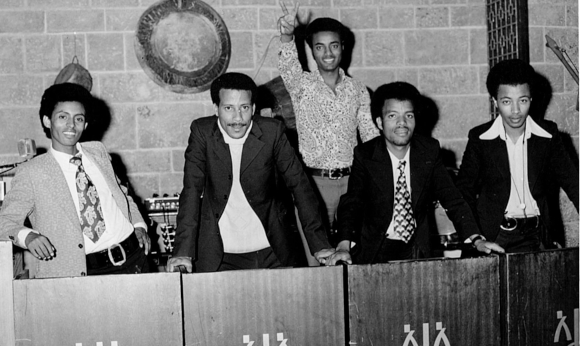
Photo: Walias Band.

Friday, 7 April 2023

From the Horse's Mouth: Postcard from Antrobus, Cheshire

First published in Songlines Magazine issue 187, May 2023.


Outside the front entrance of a village pub in mid-Cheshire, an autumnal drizzle just about starting, a motley gang has assembled with all manner of strange costumes and disguises. An ambassador has already run ahead to warn the bar staff and order in a round. Then, as one, the group opens their mouths and start singing: “Here come one, two, three jolly good hearty lads, and we’re all in one mind / For this night we come a-souling, good nature to find / for this night we come a-souling as it does appear / and it’s all that we are souling for is your ale and strong beer.” Inside, some unsuspecting patrons look around quizzically, wondering what the fuss is about. Once the singing has finished, there is a loud knock on the front door and all hell breaks loose.

This is a typical visit of the Antrobus Soul-Cakers, who come together every year to continue mid-Cheshire’s most iconic folk tradition. Soul-Caking is a real hodgepodge of a custom – part-play, part-visitation, part-fertility ritual of unknown ancient origin – performed on October 31 (and for a couple of weeks afterwards) at pubs throughout the region, usually four per night. Once, every village had its own Soul-Caking gang, but nowadays Antrobus is the only one with an unbroken lineage stretching back centuries.

Officially, I’m here to record the performances for the British Library sound archive, adding to the recordings of the same group from the 1950s and 1970s. We met up at the gang’s base at the Antrobus Arms to chat and listen to the old recordings, and then it’s off to delight the patrons of pubs in nearby Stretton, Rudheath, Davenham and Moulton with my recording equipment in tow. But I’m actually here for a more personal reason.

I’m from Cheshire – I grew up in a village only four miles away from Antrobus – yet I’d never even heard of Soul-Caking until after I’d left home, moved to the city and gained a belated interest in folk music and traditions in earnest. That such an important, old and well-known custom had existed just down the road from me without ever entering my consciousness left me in wonder, and with a tinge of shame. I’ve returned to finally witness a living part of my home culture for the first time.

So I find myself in a pub, surrounded by madness. The play is a whirlwind of sword-fights, madcap characters, shrieking, bellowing, poetry, jokes, braggadocio, heckling, light-hearted pint theft and a star turn by Dick the Horse, a real horse’s skull painted black, white and red, with a jaw that snaps at the command of its puppeteer hidden under a sackcloth body. After 20-or-so minutes, and with a final song and a quick drink afterwards, the gang are away to their next stop.


For the punters in the pub, it can all be a bit baffling. Some people know it’s happening and have come down especially. Others are completely bemused: pleasant family meals and girls’-nights-out are interrupted by the completely unexplained chaos. Some take it well, gazing with perplexed wonderment and getting into the spirit of things by the end; others ignore the weirdness with bored indifference, and a few – always men – seem to take its existence in their space as an insult or challenge and get a bit aggressive.

Each pub has its own distinctive atmosphere and audience, and a different performance because of it. Some pubs are electric, everyone gets into it and the Soul-Cakers adlib all over the place; in others, the crowd is dead and the play is rushed through as quickly as possible, with a bunch of material skipped and much grumbling from the players. Every performance is a new experience – it also helps that everyone becomes successively more lubricated as the night wears on. In true folk fashion, things stay the same while changing constantly.

I leave the last pub at gone midnight, knackered, tipsy and slightly stung by a few errant whips of a riding crop, but absolutely buzzing. My official duties are fulfilled, and my soul feels nourished too. Not only have I experienced an important part of my own cultural heritage for the very first time, but I’m back speaking in a broad Cheshire accent I hadn’t even noticed I’d lost. What an honour.

At the end of each play, to cheers from the pub-goers and a frying-pan passed around to collect for charity, the Antrobus Soul-Cakers strike up for a final verse: “And now our play is ended, and we can no longer stay / But with your kind permission we will come another day / But before we go, we’ll have you to know, we'll have you to understand / We’re a credit to old England, we’re the boys of the Antrobus gang!”


Photos: (top) The Antrobus Soul-Cakers in their natural habitat (the pub); (middle) Dick the Horse and his driver. Both photos by Nigel Farr.