Showing posts with label Book Review. Show all posts

Friday, 3 September 2021

Garth Cartwright & Quintina Valero - London’s Record Shops

First published in Songlines Magazine issue 171, October 2021.

Garth Cartwright & Quintina Valero
London’s Record Shops
The History Press (176 pages)

Following on from his 2018 deep dive into the social history of the UK’s record shops, Going on a Song, author and regular Songlines contributor Garth Cartwright has teamed up with photographer Quintina Valero to document the shape of London’s record trade during one of its most uncertain periods.

Cartwright and Valero visited 36 record shops around the capital, grouped into seven distinct neighbourhoods of Soho, Camden, Ladbroke Grove, Brixton, Peckham & Camberwell, Hackney and Whitechapel. Each shop gets its own profile, varying in length from a couple of paragraphs’ description to a detailed chronology and in-depth interview with owners. On top of that, each district is explored in terms of its musical history and legendary record shops and venues sadly lost to the ages.

The lovely thing about the book is that the ‘shop’ aspect of the record shops isn’t the focus. Instead it’s a love letter to the culture of these small shrines to good music, and the passion, knowledge and enthusiasm of the characters that exist within their orbit. The shops and their people reflect all manner of musical styles, subcultures, clientele, ages and opinions, a great snapshot of the huge diversity and all-encompassing nature of London’s musical scene. It also serves as a historical document: the unmistakable shadow of the COVID-19 pandemic looms large over many of the interviews, photographs and stories, very much placing this book in this specific time.

In terms of a ‘coffee table book’, London’s Record Shops ticks all the boxes. It’s full of beautiful, interesting and informative photographs to leaf through at leisure, and the text provides an enjoyable read, even in a dip-in-and-out way. And if you ever find yourself in London with a spare afternoon, it would doubtless serve as an essential guidebook. Just remember to bring your wallet.
Friday, 9 April 2021

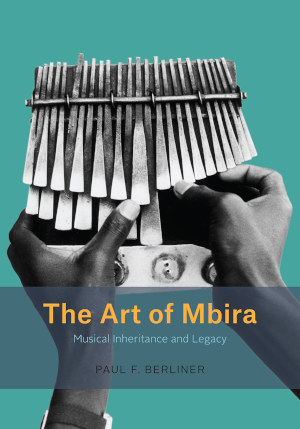
Paul F. Berliner - The Art of Mbira: Musical Inheritance and Legacy

First published in Songlines Magazine issue 167, May 2021.

Paul F. Berliner
The Art of Mbira: Musical Inheritance and Legacy
The University of Chicago Press (608 pages)

At its heart, this book began in 1971, when Paul Berliner first met mbira player Cosmas Magaya and started a life-long friendship. Such a long-standing relationship gives Berliner and Magaya insights into the mbira that can only have developed through decades of deep thought, matured through constant conversation and mediation. Berliner uses Magaya’s performances to explain the intricacies of mbira playing: how pieces are composed and evolve over time; how the rhythms, harmonies, melodies and texture work together to create a complex and unique musical style; how players vary, improvise, create and recreate mbira pieces and parts; and how the tradition is taught and learnt. Magaya’s presence here is all-encompassing and indelible, arguably deserving a co-author’s credit. His death in July 2020, just months after publication, adds a poignancy to his quote in the book’s introduction: ‘Once we’ve completed this study on behalf of our late mbira-playing comrades – leaving it for others who come behind us – I will know that if I die tomorrow, I can go to my grave satisfied.’

This book really is a monster tome, with over 600 (large) pages and 300 musical examples – and on top of that, there’s a whole website with hundreds of recordings cross-referenced with the text, and an even larger companion book, Mbira’s Restless Dance (912 pages!), with over 500 transcriptions of mbira music. It’s a multimedia magnum opus, and it’s a lot to get through.

The Art of Mbira is a landmark work that will be indispensable for scholars of mbira, Zimbabwean music, music pedagogy, music psychology and for ethnomusicologists and musicologists alike; it will also be a boon to budding mbira players. It’s worth bearing in mind though: this isn’t a book for light reading. It can get very technical and, although Berliner has a knack for evocative description, the academic discussion can be dry verging on impassable. This is an incredible book, and the culmination of two lifetimes of work, but proceed with caution.

Friday, 1 November 2019

Food for the Ears, Music for the Tastebuds

First published in Songlines Magazine issue 153, December 2019.

Cerys Matthews is a person of many talents – singer-songwriter, BBC radio DJ, festival curator, author…and if her latest book is anything to go by, she’s also a mean cook.

In Where The Wild Cooks Go, Matthews discusses food and drink from all around the world, offering simple and sustainable recipes collected during her travels and honed at home. Each chapter is filled with thoughts, history and poetry from the region at hand. Music obviously plays an important role, too: “I’ve always cooked, and I always cook to music, as so many of us do – I get messages from people from their kitchens every Sunday when my radio show goes out,” says Matthews. “This exchange made me want to publish this kooky kind of cookbook: full of the recipes, curiosities and nuggets of wisdom I’d been scribbling in my song book for ever.”

The musical connection is harder to put across in the writing, so Matthews has also curated Spotify playlists of music associated with every culture covered in the book – 15 in total – to listen to as you cook, eat… or any other time. Where The Wild Cooks Go is less a recipe book and more a multisensory travel guide, as well as offering a glimpse into how Matthews herself views the world: “It’s a kind of ‘folk' cookbook, inspired by those who've stirred over fires and conversations shared over the ages. It’s turned out to be almost like a world history book through the prism of food – and makes the idea of hard borders and absolute identity laughable when you read these.”

Friday, 5 April 2019

As I Walked Out: Ninebarrow's Dorset

First published in Songlines Magazine issue 147, May 2019.


After four albums in six years, English folk duo Ninebarrow’s latest release is something a little bit different: it’s a book. Not a songbook or even a book about music in general, either. Ninebarrow’s Dorset is a collection of ten scenic walks around the pair’s native lands of the Isle of Purbeck and the surrounding areas.

It may seem like a bit of a departure, but for Ninebarrow – Jon Whitley and Jay LeBouchardiere – it came naturally…and was a long time coming. “The link between the Dorset landscape and our music is one that’s been there right from the start of Ninebarrow,” says Whitley, “And to be honest, we were walking together long before we started making music together!”

Ninebarrow’s Dorset isn’t just a set of stories and evocative descriptions. Each of the ten walks is fully mapped-out and each is indelibly linked to a song from the duo’s back catalogue. As you stroll over the hills and along the coastlines, not only is there a ready-made soundtrack for your walk, but you can learn the meaning of the songs and their connections to the land upon which you stand.

The duo’s own connection to the land is evident right in their name, which they borrow from the beautiful Nine Barrow Down near Swanage. They certainly wouldn’t have chosen anywhere else to write about. “I think Dorset has a magic that is gentler than some of the other beautiful places on a walker’s radar,” says LeBouchardiere, “It might lack the sheer grandeur of the Lake District’s mountains or the rugged drama of the Cornish coast, but you never have to climb too far to get glorious views over the hills and the surrounding water.”

Friday, 12 May 2017

Jennifer W. Kyker - Oliver Mtukudzi: Living Tuku Music in Zimbabwe

First published in Songlines Magazine issue 128, June 2017.

Jennifer W. Kyker
Oliver Mtukudzi: Living Tuku Music in Zimbabwe
Indiana University Press (304 pages)

Oliver Mtukudzi – often known simply as ‘Tuku’ – is a living legend of Zimbabwean music, both within the country and out. His unique mix of traditional Shona styles, soul, jive and South African music consistently defies any other categorisation than simply ‘Tuku music’, and his lyrics have spoken to the hearts of several generations of listeners in Zimbabwe.

With this book, Kyker gives an account of Mtukudzi’s musical life, but to call it a biography would be misleading. While it does take a mostly chronological journey through Tuku’s story, it uses his life and music as a jumping-off point to talk about the role of music across various facets of Zimbabwean social life and history.

The major theme of Living Tuku Music in Zimbabwe is the Shona concept of hunhu – the idea of personal identity based on communality and constant renegotiation, or in Tuku’s words, “being a person among others”. Due to the depth and poetry of Tuku’s music and lyrics, his songs can be interpreted in a multitude of ways, often leading to different groups taking away different messages, even if they are the opposite to Tuku’s stated intent. As such, each chapter focuses on a specific topic (such as politics, HIV/AIDS, the Zimbabwean diaspora), which is then viewed through the dual lens of Mtukudzi’s songs and his audiences’ interpretations of them, demonstrating the hunhu inherent in his music.

As an essentially ethnomusicological text, the theoretical extrapolations and dense technical language may be off-putting for some readers, but there isn’t too much of this to render it completely opaque. Scattered throughout are plentiful lyrics, interviews, photographs and other assorted miscellanea, which provide nice breaks in the wall of words. This is a work that has been in the making for 13 years (including nine years of research), and Kyker has created a thoroughly fascinating book.

Sunday, 16 November 2014

Jan Fairley - Living Politics, Making Music: The Writings of Jan Fairley

First published in fRoots issue 378, December 2014

Jan Fairley
Living Politics, Making Music: The Writings of Jan Fairley
Edited by Simon Frith, Stan Rijven and Ian Christie
Ashgate (218 pages)

In 2012, world music lost one of its greatest writers. Even before the term ‘world music’ was coined, Jan Fairley was writing about the music that she loved, regardless of their place or time. Living Politics, Making Music has been compiled from Fairley’s works spanning 28 years (1984 to 2012) and it serves as a great tribute.

Although this book is presented as an academic work (and with a price that would indicate the same – ‎hardback copies are on sale for £100 or more), the collection features writings from popular journals, such as fRoots and Songlines, as well as more scholarly publications. Fairley’s writing is a good mix of the two – the more academic-leaning texts do not approach the dryness that other ethnomusicologists seem unable to escape, and the more popular articles contain an impressive depth in their brevity.

The book is divided into sections, for each of the areas Fairley covered most extensively: writings on Chile; discussions of ‘world music’; writings on Cuba, and a selection of artist interviews conducted for fRoots. The eclecticism of Fairley’s topics is also very impressive – although she mainly examines Latin American styles, she writes with equal authority, passion and imagination on topics of folk, classical or pop music, of the meanings of dance, the mechanics of radio or the workings of the music business.

This book isn’t just useful as a tribute to a great writer, it also genuinely works well along a theme. The chapters are compiled in a way that leads the reader through the most important points about music and politics in Latin America, and the role that world music and ethnomusicology can play in both. In the end, readers will no doubt be enlightened on the subjects that Fairley so eloquently explained, through a book that highlights, if it were needed, what a loss Jan’s was to the world music scene.