Friday, 14 May 2021

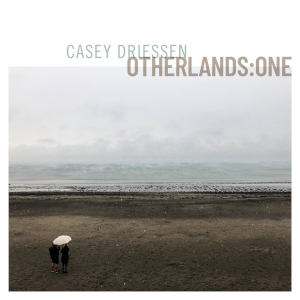
Casey Driessen - Otherlands:ONE

First published in Songlines Magazine issue 168, June 2021.

Casey Driessen
Otherlands:ONE
Red Shoe Records (84 mins)

American fiddler Casey Driessen spent nine months travelling the world, meeting, listening and playing with local musicians until COVID-19 eventually ground everything to a halt. Otherlands:ONE is the result: an album of all-acoustic collaborations with folk musicians from Galicia, Ireland, Scotland, India, Japan and Finland, each recorded on the guests’ home turf.

Although Driessen’s background is in bluegrass, his collaborations here aren’t exactly ‘fusions’ with all the heavy-handedness that term may suggest. It’s a much more sympathetic meeting. Driessen bends his style to that of his hosts, his bluegrass more of a polite suggestion than an imposition.

A lot is explored in the album’s 13 tracks, from the pan-Celtic folk styles of Western Europe to the songs of Baul musicians in Bengal, and even bluegrass itself with mandolinist Taro Inoue in Japan. The sound that binds it all, however, is of musicians really enjoying themselves. You can hear it in the music and the atmosphere, and in the little glimpses of chat we get at the end of each performance – as well as in the perfectly-captured hubbub of a pub session in County Clare.

This is a really lovely album with good vibes aplenty. Hopefully Driessen can get back to globetrotting and collaborating again soon!

Transglobal Underground and Our European Friends - A Gathering of Strangers 2021

First published in Songlines Magazine issue 168, June 2021.

Transglobal Underground and Our European Friends
A Gathering of Strangers 2021
Mule Satellite (47 mins)

A Gathering of Strangers first saw light in 2010 when it was released by a pan-EU collective headed by dubtronic pioneers Transglobal Underground, under the moniker Urban Native Integrated Traditions of Europe – or UNITE. Now it’s been remastered, remixed and re-released as part of TGU’s ambitious one-album-a-month challenge for 2021.

The project features guests from Bulgaria, Hungary, Poland, the Czech Republic, Ireland and the UK, with stars of folk, hip-hop and electronica all getting involved. This united European front, together with a theme of longing that threads through the whole album, makes this a compelling collection of protest anthems from the resistance, created while Brexit was still the dream of a fringe lunacy.

The strange thing is that a side-by-side comparison with the original isn’t particularly kind on the 2021 edition, soundwise. The 2010 release just feels meatier, its basses more full and its tops more resonant. Add in the fact that the new version has five fewer tracks, it all makes for a rather odd remaster.

Like its source material, A Gathering of Strangers 2021 is still a very good album and a great listen on its own… but it might be best to track down a copy of the original before settling for this update.

Wednesday, 5 May 2021

Khalab & M’berra Ensemble - M’berra

First published on The Quietus.

Khalab & M’berra Ensemble
M’berra
Real World Records (37 mins)

Real World Records’ latest release harks back to the label’s grand tradition of intercultural collaborative fusion as Italian DJ and producer Raffaele Costantino – better known as Khalab – meets and mingles with the musician residents of the M’berra refugee camp in south-eastern Mauritania.

M’berra has existed since the early 1990s, when people fled violence in neighbouring northern Mali. Its population has fluctuated with relative periods of peace and war in the region, but recently there have been as many as 60,000 people living in the desert settlement. Khalab visited M’berra in 2017 to meet its people, record its sounds and, it turns out, to create a 14-strong ensemble of Tuareg and Hassaniyya musicians, playing their own music in their own styles together. Among the musicians are members of groups such as Tartit, Tafalawist and Imarhan Timbuktu – from the population of a refugee camp, a supergroup.

Read the full review over at The Quietus.

Monday, 26 April 2021

The Biram: The World’s Rarest Traditional Musical Instrument?

First published on the British Library Sound and Vision blog.


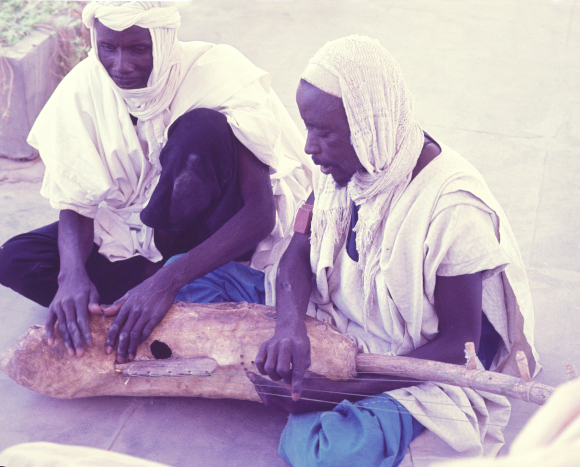
The focus of this week’s recording is unusual in a few different ways. It’s a recording of the biram, made in the city of N'guigmi in Niger, probably in the mid- to late-80s. The biram is a large boat-shaped arched harp played by the Buduma people, traditionally fishermen and cattle-herders on the shores and islands of Lake Chad. While similar harps are fairly common in Central Africa, the biram is the only one of its type in West Africa, and may have even evolved from an instrument of the Ancient Egyptians.

For most instruments, the relationship between object and operator is simple – one instrument has one player. The biram is not quite so simple. In fact, it has two players, both making a completely different sound.

To read the full blog post and to listen to the recording of Buduma music performed on the biram, head over to the British Library Sound and Vision blog.


Photo: Buduma musicians playing the biram, 1967. Photo courtesy of Guy Immega.

Friday, 9 April 2021

Essential 10: Live Albums

First published in Songlines Magazine issue 167, May 2021.

Nikhil Banerjee
Afternoon Ragas (Raga Records, 1992)
This performance by sitar great Nikhil Banerjee, recorded in a museum in Rotterdam in 1970, is simply supreme. The 10-minute alap on Raga Bhimpalasri that opens the album is surely one of the most transcendent ever put to record. Accompanied by Kanai Dutta on tabla, Banerjee guides us through the serenity and the fireworks of ragas Bhimpilasri and Multani. Forget Rotterdam, this album can take you somewhere else entirely.

Bisserov Sisters
Music from the Pirin Mountains (PAN Records, 1990)
Recorded in concert at the Paradiso in Amsterdam, the Bisserov Sisters (together with their instrumentalists the Trio Karadzovska) give a whirlwind tour of the many folk styles of the south-western Bulgarian mountain village of Pirin, from the iconic vocal polyphony to all-instrumental dances and lots more in between. Beautifully performed, the resulting 26-track album is interesting and intriguing in equal measure.

Fatoumata Diawara & Roberto Fonseca
At Home: Live in Marciac (Jazz Village, 2015)
Of many attempted African-Latin collaborations, this is among the best. Between Diawara’s breathtaking voice and Fonseca’s nimble Cuban jazz piano, the connection feels completely natural, unforced and personal. Powerful and driving or subtle and sweet, the two masters match each other every step of the way. This recording from the Jazz in Marciac festival remains their only full-length release together.

Oum Kalthoum
Al Atlal (Sono Cairo, 1966)
Oum Kalthoum is one of the world’s bona fide megastars, revered not only in her native Egypt but across the Arab world and far beyond. She was known for her extended live performances, and Al Atlal (The Ruin) consists of a single 48-minute song of melancholy, despair and utter beauty. It is widely considered to be Kalthoum’s greatest achievement, maybe even the greatest Arabic song ever sung.

Ozomatli
Live at the Fillmore (Concord Records, 2005)
How much dancing is your body ready for? Mariachi, cumbia, salsa, norteño, hip-hop, funk, rock, samba and influences from every continent: it’s all here in one band. Ozomatli are one of the greatest of all party bands, known for their on-stage and in-crowd antics as well as their social consciousness. This sweat-soaked CD+DVD set gives a clue as to the dangerously high levels of ecstatic energy they bring.


Radio Tarifa
Fiebre (World Circuit, 2003)
The Iberian Peninsula and North Africa are only 13km apart, but Radio Tarifa’s music makes them feel even closer. Here, Spanish flamenco and Moroccan chaabi become one and the same. This retrospective-in-concert of the group’s first ten years results in a smoldering album that occasionally bursts out into full flamenco flame without ever leaving the souk.

Rachid Taha, Khaled, Faudel
1, 2, 3 Soleils (Barclay France, 1998)
This one-off supergroup show at Paris’ Bercy Stadium by the three biggest voices in rai – the king Khaled, the prince Faudel and the rebel Taha – was always going to be an extravaganza. With a 40-piece orchestra on top of the usual rai ensemble, this 2CD album is cheesy Algerian pop at its best. No wonder they sold out a stadium.

Lobi Traoré
Bamako Nights: Live at Bar Bozo 1995 (Glitterbeat, 2013)
There’s worse places to be than in a small, crowded bar in perhaps the world’s most musical city. Bamako Nights presents one of guitarist Lobi Traoré’s regular all-nighters in the Malian capital’s grungiest bar. Traoré’s electric Bamana blues is sometimes brooding, sometimes roaring, always grooving. And when he goes full-on Hendrix, it seems like Bar Bozo would be the best place on Earth.

Various Artists
Le Festival au Désert (Independent Records, 2003)
The Festival in the Desert is one of those legendary events spoken about in hushed, reverential tones: a stage set up in the village of Essakane in the Sahara desert where local Tuareg musicians rubbed shoulders with Malian giants and international stars, surrounded by camel races and fire dancers. It would sound like fantasy if we didn’t have recorded evidence that it happened.

Various Artists
Music and Rhythm: WOMAD 1982-2007 (WOMAD, 2007)
WOMAD is the standard bearer for world music festivals across the globe, and this 25th anniversary souvenir set tells its story with three CDs and a book. It features rare and wonderful live recordings from throughout the festival’s history, including the very first piece performed at the inaugural event in 1982 – ‘Raindrops Pattering on Banana Leaves’ by the Tianjin Music and Dance Ensemble.
Paul F. Berliner - The Art of Mbira: Musical Inheritance and Legacy

First published in Songlines Magazine issue 167, May 2021.

Paul F. Berliner
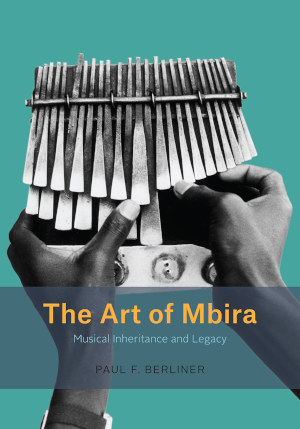
The Art of Mbira: Musical Inheritance and Legacy
The University of Chicago Press (608 pages)

At its heart, this book began in 1971, when Paul Berliner first met mbira player Cosmas Magaya and started a life-long friendship. Such a long-standing relationship gives Berliner and Magaya insights into the mbira that can only have developed through decades of deep thought, matured through constant conversation and mediation. Berliner uses Magaya’s performances to explain the intricacies of mbira playing: how pieces are composed and evolve over time; how the rhythms, harmonies, melodies and texture work together to create a complex and unique musical style; how players vary, improvise, create and recreate mbira pieces and parts; and how the tradition is taught and learnt. Magaya’s presence here is all-encompassing and indelible, arguably deserving a co-author’s credit. His death in July 2020, just months after publication, adds a poignancy to his quote in the book’s introduction: ‘Once we’ve completed this study on behalf of our late mbira-playing comrades – leaving it for others who come behind us – I will know that if I die tomorrow, I can go to my grave satisfied.’

This book really is a monster tome, with over 600 (large) pages and 300 musical examples – and on top of that, there’s a whole website with hundreds of recordings cross-referenced with the text, and an even larger companion book, Mbira’s Restless Dance (912 pages!), with over 500 transcriptions of mbira music. It’s a multimedia magnum opus, and it’s a lot to get through.

The Art of Mbira is a landmark work that will be indispensable for scholars of mbira, Zimbabwean music, music pedagogy, music psychology and for ethnomusicologists and musicologists alike; it will also be a boon to budding mbira players. It’s worth bearing in mind though: this isn’t a book for light reading. It can get very technical and, although Berliner has a knack for evocative description, the academic discussion can be dry verging on impassable. This is an incredible book, and the culmination of two lifetimes of work, but proceed with caution.

4 Mars - Super Somali Sounds from the Gulf of Tadjoura

First published in Songlines Magazine issue 167, May 2021.

4 Mars
Super Somali Sounds from the Gulf of Tadjoura
Ostinato Records (73 mins)

As part of their on-going relationship with Radiodiffusion-Télévision de Djibouti, Ostinato Records launch the first instalment of their new Djibouti Archives releases to bring the country’s unique sounds to international ears for the first time.

The series starts with 4 Mars, the official band of the People’s Rally for Progress, Djibouti’s ruling party since independence. You’d be forgiven for thinking that their music would be stuffy and bureaucratic, but these recordings – made between 1982 and 1994 – can hold their own among the best of African rare groove.

Amid their drum machines, horn sections, synthesizers, electric guitars and array of impressive vocalists, 4 Mars strike at something that represents the essence of their country, where tradition and internationalism are equally important. The musics of Ethiopia, Sudan and Egypt loom large, and from the other side of the Red Sea, they take elements from Yemen, Turkey and India. They add in reggae, funk and jazz from across the Atlantic, and filter it into their own sound to create something still recognisably Somali in its loping beat and vocal melodies and rhythms. It’s a definitively Djiboutian mix.

At their height, 4 Mars were a 40-strong troupe of musicians, singers, actors, dancers and folklorists designed to show Djibouti in the best possible light. Now they get another chance to shine.